Riflescope Troubleshooting: Blurry Image, Dim View & Reticle Issues
9 min reading time
90% of “Broken Scopes” Are Not Broken
Every shooter has experienced it: you lift your scope, and the picture is fuzzy, dark, or the illuminated reticle flickers. Most users immediately assume their riflescope is defective, damaged, or cheaply built.
But after years of field testing and optic troubleshooting, one truth stands out: over 90% of blurry, dim, or flickering scope issues are user error or minor environmental problems — not hardware failure.
The dangerous part? Many shooters misdiagnose simple setup errors as damage, waste money replacing functional scopes, or worse — disassemble their optics and turn a tiny issue into permanent destruction.
This advanced troubleshooting guide dives beyond basic cleaning tips. We break down the optical physics behind blurry images, explain why scopes dim at high magnification, uncover hidden reticle electronics failures, and teach you how to 100% distinguish user mistake from real scope damage.
Blurry Scope Image: The Hidden Diopter Mistake (Most Common & Most Misdiagnosed)
A blurry scope image is the #1 complaint, yet almost no shooters understand why it happens.
There are two completely separate focus systems inside a riflescope:
Diopter (Eyepiece Focus) = Focuses the RETICLE
Parallax / AO / Side Focus = Focuses the TARGET
These two systems do not overlap.
If you ignore this rule, your scope will always look blurry — even if the lens is brand new and perfectly clean.
The Classic New-Shooter Mistake
Most users try to “focus the target” using the eyepiece diopter. This permanently ruins both reticle clarity and target sharpness.
Correct Professional Workflow (Non-Negotiable)
Set your scope to mid-magnification
Aim at a blank bright background (sky/wall) with closed or distant-focused eyes
Rotate diopter until the reticle etching snaps instantly razor sharp
Lock diopter ring
Use side-focus/AO knob to clean up target image
How to Tell If Your Blur Is User Error or Real Damage
Blur moves with magnification change → Normal optical distortion / user setup
Reticle never sharpens, no matter diopter adjustment → Internal lens shift or collimation damage
Dim Scope View: Why Your Scope Looks Dark (It’s Rarely the Scope’s Fault)
A dim sight picture is one of the most misunderstood optical behaviors. Shooters often think “dark view = bad scope,” but physics tells a different story.
Every riflescope loses light as zoom increases. This is caused by shrinking exit pupil size.
Exit Pupil = Objective Size ÷ Magnification
Example: A 4-16x50 scope at 16x produces only a 3.1mm exit pupil — far smaller than the human eye’s low-light pupil. The result is a drastically darker view at max zoom. This is normal physics, not scope defect.
2. Invisible Lens Contamination (The Silent Brightness Killer)
Fingerprints, skin oil, and fine dust do not look visible on glass — but they destroy light transmission. A single faint fingerprint can reduce light transmission by 10–15%.
Paper towels, shirt sleeves, and rough cloths create micro-scratches that slowly degrade multi-coatings over time, causing permanent dimness.
3. Coating Degradation (True Permanent Damage)
If your scope stays dim even at low magnification with perfectly clean lenses, you are looking at real damage: worn anti-reflective coatings, internal haze, or degraded cement between lens elements.
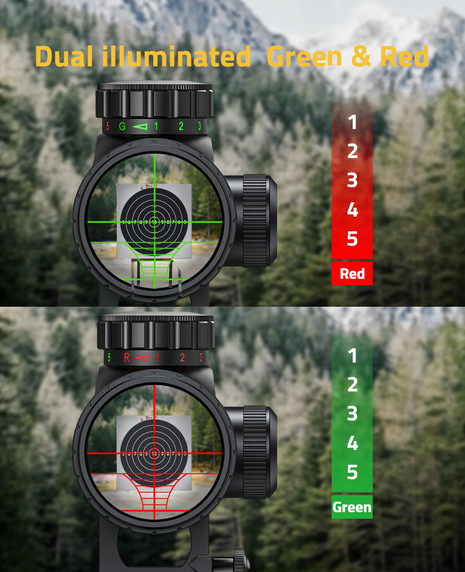
Reticle ghost glow / residual light: Internal circuit board capacitance (normal on premium scopes, not damage)
No illumination at all: Wrong battery polarity, damaged contact spring, or internal water short
Professional Trick: If your reticle flickers only during recoil or walking vibration, it is loose contact — not a broken board.
Scope Fogging: Condensation vs. Seal Failure (Critical Distinction)
Most shooters panic when they see fog inside their scope. But there are two completely different types of fog — one harmless, one fatal.
1. External Temporary Fog (Normal)
Quick temperature swings (cold outdoor air + warm hand heat) create external lens condensation. It wipes off within seconds and never returns after lens temperature stabilizes.
No damage, no warranty issue, no repair needed.
2. Internal Fog & Trapped Moisture (Permanent Damage)
If fog appears inside the tube and cannot be wiped away, your scope has lost its nitrogen purge and O-ring seal integrity.
Failed waterproofing allows humid air inside the tube. Over time:
Internal lens elements grow micro-water spots
Optical cement degrades
Illumination circuits corrode
Permanent haze ruins image clarity forever
Once nitrogen leaks out, a scope will never fully clear up on its own.
Why You Should NEVER Disassemble Your Riflescope (Industry Secret)
When faced with fog, blur, or dimness, many advanced users attempt self-repair. This is the #2 way shooters destroy functional scopes.
Disassembly Causes Permanent Hidden Damage:
Lens collimation shift: Internal lens alignment is factory-calibrated within microns. Opening the tube misaligns optical centers, creating impossible-to-fix parallax error and blurred edges.
Nitrogen purge loss: Consumer tools cannot re-purge dry nitrogen. Your scope will fog forever after.
Turret zero drift: Internal gear and spring tension shifts, ruining repeatable click values
Warranty void: All internal disassembly terminates factory coverage
Rule of thumb: If the problem is inside the scope — do not open it. Send it for professional service.
Advanced Diagnostic Table: User Error vs. Real Optic Damage
Symptom
Root Cause
Verdict
Blurry reticle only
Diopter misadjusted
User Error
Blurry target, sharp reticle
Parallax/focus uncalibrated
User Error
Dim view only at max zoom
Exit pupil physics limitation
Normal Optical Behavior
Dim view at all magnifications
Coating wear or internal haze
Real Scope Damage
Flickers on recoil
Loose battery contact
User Error / Minor Fix
Persistent inside fog
Broken seal / lost nitrogen
Real Scope Damage
Scratched lens, permanent flare
Physical coating damage
Real Scope Damage
Final Pro Troubleshooting Workflow (Save Time & Avoid Wrong Judgments)
Always troubleshoot in this exact order before concluding your scope is broken:
Reset and recalibrate diopter
Clean lenses with professional optic cloth
Replace battery and clean contacts
Test brightness at low/mid/high magnification
Check fog location (external vs internal)
If problem persists → professional service required
Most riflescope image and reticle problems are not failures — they are misunderstood optical behaviors and setup errors. Knowing the difference saves you from unnecessary scope replacements, wasted money, and ruined field days.