How They Work: The Core Difference
Both red dot and holographic sights fall under the broader category of electronic dot optics, designed to let you acquire a target and align your shot without squinting through a traditional scope. But the engineering underneath is quite different.
A red dot sight uses an LED (light-emitting diode) to project a single red dot onto a reflective coated lens. The dot appears to float in front of your target when your eye is aligned correctly. The technology is elegant and decades old — think of it as a laser pointer bouncing off a mirror.
A holographic sight, by contrast, projects a reticle (which can be more complex than a simple dot) onto a holographic film embedded inside the optic window. Rather than reflecting an LED, the system displays a true holographic image at a fixed distance behind the glass. This means the reticle is less affected by the position of your eye — you can move your head around and the reticle stays consistent.
Key Spec Comparison
| Feature | Red Dot Sight | Holographic Sight |
|---|---|---|
| Reticle type | Dot, Circle, Cross | Complex reticles (dots, circles, grids) |
| Eye relief | Limited — must center eye behind glass | Unlimited — wider head movement allowed |
| Field of view | Good | Excellent |
| Parallax | Near-zero at designated distance | Negligible at all distances |
| Battery life | 10,000–50,000 hours (LED efficiency) | 250–1,000 hours (holographic projection) |
| Weight / Size | Light and compact | Slightly heavier, taller window |
| Astigmatism sensitivity | Higher — dot can blur or elongate | Lower — reticle often stays crisper |
Real-World Performance: What Actually Changes on the Range
Target Acquisition Speed
In timed drills, both optic types dramatically outperform iron sights when it comes to target acquisition speed. That said, experienced shooters often report that holographic sights feel slightly faster in transitional shooting — the kind of snap-shoot where you're moving between targets and can't afford a perfect cheek weld.
"My first time with a red dot, I honestly couldn't believe how fast I found the point. I was expecting some learning curve, but my group shots tightened up on the second magazine." — a forum member describing his first range session with an electronic dot optic.

Eye Relief & Shooting Position
Here's where holographic sights pull ahead for some shooters. With a red dot sight, you're working with finite eye relief — your eye needs to be within a relatively tight window behind the optic to see the dot clearly. This is fine on a rifle with a fixed stock, but it matters more in these scenarios:
- Home defense: You might hold the rifle at awkward angles, close quarters, one-handed.
- Under-vehicle or unconventional positions: CQB stages, competition lanes with weird holds.
- Moving targets: If your head position shifts while tracking.
Holographic sights give you more freedom here. Because the reticle is projected at a fixed virtual distance, small head movements don't cause the reticle to float away from your point of aim the way a red dot can.
Low-Light Performance
Both systems perform well in low light, but holographic optics often have a subtle edge when the sun drops — the projected reticle pops more vividly against a dark background. Red dot sights in this category depend heavily on the quality of their LED and the dot's brightness settings. On the flip side, a good quality red dot with a wide brightness range is perfectly usable from golden hour through dusk.
The Astigmatism Test: What It Is & Why It Matters
Here's the section we get asked about the most. Let's fix that.
If you have astigmatism, the cornea of your eye doesn't curve evenly. Light bends differently in different planes, and the result is that a simple round dot — like the one in a red dot sight — can appear stretched, smeared, or comet-shaped to you. It's not the optic's fault. It's physics meeting biology.
Many shooters with mild to moderate astigmatism don't even know they have it until they look through a red dot for the first time. If you've ever thought "that dot looks blurry no matter what I do," this is very likely why.

Quick At-Home Astigmatism Test
You don't need a doctor's appointment to get a first signal. Try this in 30 seconds:
Step 1
Look at a distant bright light (a ceiling LED, street light at night) with one eye covered. Does the light source appear as a perfect starburst or more of a smudged, streaked blob?
Step 2
Look through a friend's red dot sight (or at any bright dot on a screen). Does the dot look round or stretched? Does it have a tail or comet smear?
Step 3
Do the same with a holographic sight if possible. Many astigmatism users report the holographic reticle appears noticeably cleaner.
Result
If the dot looks smudged or elongated in Steps 1–2 but noticeably better in Step 3, you very likely have astigmatism. Consult an optometrist for confirmation.
Beyond that, there are a few other things that affect how optics look to astigmatism eyes:
- Dot size matters: Larger dots (3–4 MOA) can actually look cleaner than tiny 1 MOA dots for some astigmatism users, because the smear spreads more evenly across the target area.
- LED color: Some shooters with astigmatism prefer the slightly different wavelength characteristics of green dots over red. There's no universal rule — try both if you can.
- Optic quality: Higher-quality lenses with better multi-layer coatings can reduce aberration artifacts that mimic or worsen astigmatism effects.
Our Recommended Picks at CVLife
We stock optics for every budget and use case. Here are two of our most popular picks that represent the best of each category:

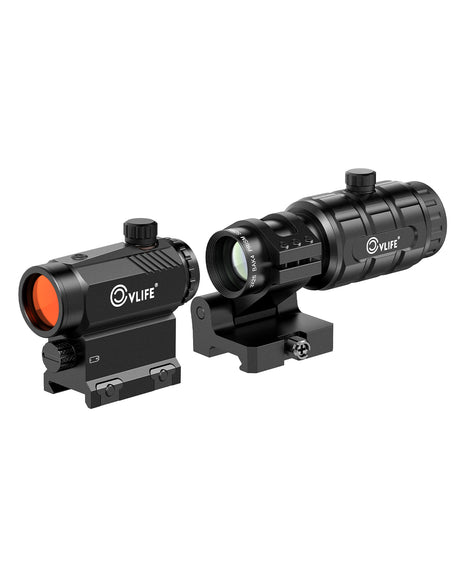
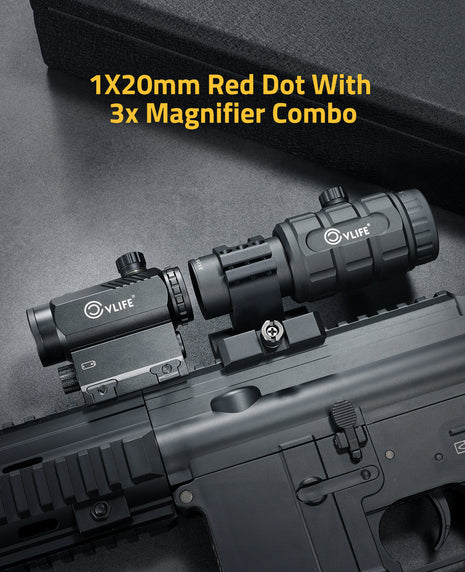
Red dot and magnifier sight are designed to extend your effective range. This optic magnifier triples the standard red dot sight's magnification, ensuring precise targeting at longer distances, while a comfortable 2.36-inch eye relief maintains a wide field of view.
- Motion awake technology
- 10 bright settings(including 2NV)
- Crisp 2MOA red dot
- Works with magnifiers

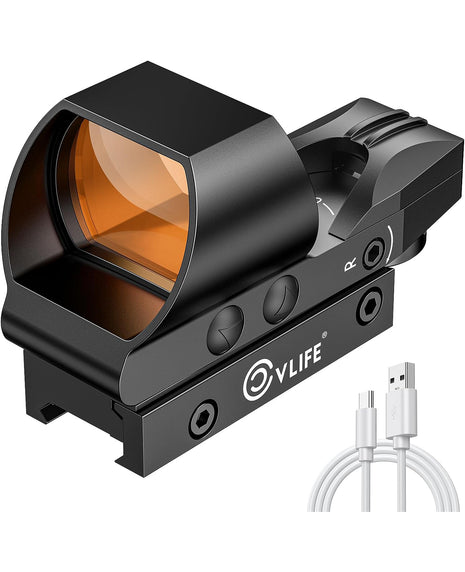
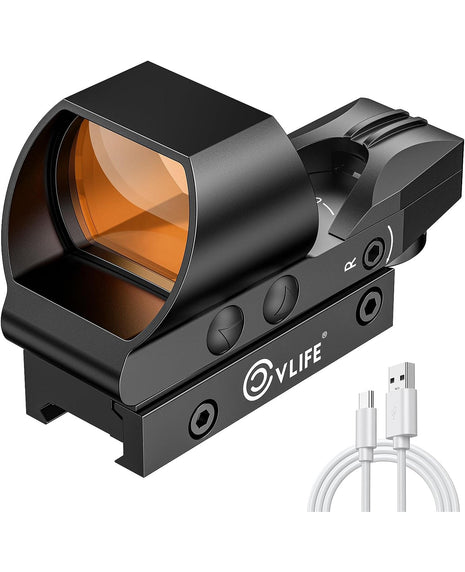
Features a holographic-style reticle pattern — combining a precise central dot with additional aiming reference marks.
- Holographic-style reticle (dot + circle options)
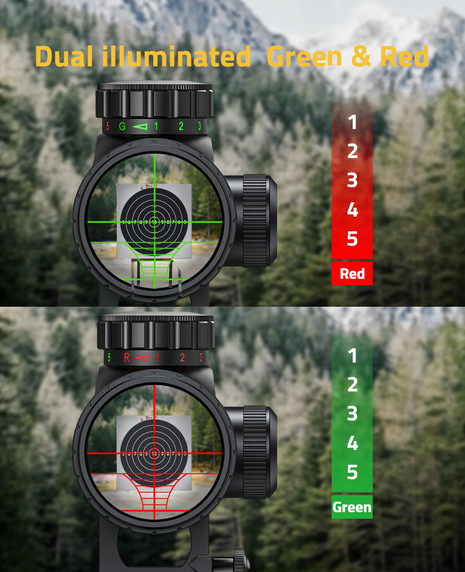
- Red and green illumination modes
- Wide viewing window
Which Should You Buy? A Shooter's Decision Guide
General specs tell part of the story. Here is how the choice plays out across the most common shooter profiles:
🎯 First-Time Shooter
A red dot sight is the most approachable entry point. You will be amazed at how quickly your muscle memory builds compared to iron sights. Mount it, zero it at 25 yards, and start running drill reps.
→ Start with a red dot. Upgrade later if needed.
🏕️ Hunter
Hunters often benefit most from a magnified optic for ethical shot placement at distance — but a red dot as a fast-acquisition secondary optic is an excellent choice for close-in brush hunting. The dual-illuminated feature means no battery anxiety during multi-day trips in the field.
→ Red dot with magnifier for versatility.
🏆 Competitive Shooter / 3-Gunner
Holographic-style optics shine here — the unlimited eye relief makes unconventional positions and transitions fast and reliable. The reticle complexity (dots, circles, bars) can also help with hold-over estimation on various stage distances.
→ Holographic reticle wins for competition.
🛡️ Home Defense / Tactical
Speed and simplicity win. A lightweight red dot on an AR-style platform lets you acquire threats instantly at typical indoor distances. Unlimited eye relief matters when you might hold the rifle from a hip or unconventional position. Shake-awake battery features also mean it's always ready.
→ Red dot — compact, reliable, always ready.
What Real Shooters Are Saying
Here is how these optic styles are performing for shooters in the field:
"Unboxing review for now, will update once I get to a range and set this thing up.Ammo box for size comparison, it’s much bigger than I thought it was gonna be (which I consider a positive).Product seems dense (heavy?) enough to feel like a quality product. Includes batteries which is nice. The entire product works from start to finish. Scope, knobs, laser, red / green dot site, etc. product packaged well.Overall very impressed - Will update after a range visit. For anyone who’s curious, it’s going on a Ptr-91-308"
"So I bought this for my AR and took it out to my range. First I liked it. All the light up scopes were great looking. It was easy to assemble with all the tools that they supplied. Once I got to the range….. i stopped liking it. It was just far too big and clumsy to be what i would personally be interested in. It is very large. Once i started looking the scope as a whole i realized that there were quite a few options available to me. I took everything apart and realized it didn't have to be all assembled together. I mounted the big scope on one AR and the smaller scope and laser on another AR. All the scopes have their own power source so they are all customizable. So in the end I liked it again. The scopes were convenient to sight and accurate. For under $100 I think it's a pretty sold buy.
"Was pretty accurate right out of the box after adjusting this are my results at 100 yards on my AR-15... definitely recommend"


Frequently Asked Questions
Ready to Upgrade Your Optics?
Browse the full range of red dot sights, holographic reticle optics, and scope combos at CVLife — all with free shipping when over $29 and a 30-day return policy.
Shop All Optics →