01Glass — what clarity actually means
A scope's “glass” is not a single spec — it is the combined performance of the objective lens, coatings, prisms, and ocular lens. “HD” or “ED glass” are meaningless unless the supporting optical design delivers on them.
- Objective diameter. Front lens, in mm. Sweet spot for most 2026 North American hunting: 40–50 mm. Push toward 50 mm for low-light predator or hog hunting; drop to 40 mm for backcountry weight savings.
- Exit pupil. Diameter of the light beam leaving the scope = objective ÷ magnification. A 6‑24x50 at 6x has an 8.3 mm exit pupil — wider than the human eye dilates in daylight. At 24x, the same scope has 2.1 mm — too narrow for low-light use. Variables are not “good” or “bad” — they are tuned for a use case.
- Coatings. Maximize light transmission and reduce glare. Floor: “fully multi-coated.”
- ED glass. Reduces chromatic aberration — the purple/green fringes at high-contrast edges. Matters most at long distance and high magnification.
- Set a high-contrast target at 50 yards.
- View at maximum magnification, off-axis.
- Look for color fringing at the edges. ED glass shows almost none.
- Repeat at minimum magnification. Fringing drops; distortion often rises.

A clean illuminated reticle is the result of good glass, careful lens alignment, and durable internal coatings.
| Objective diameter | Best for | Trade-off |
|---|---|---|
| 24–32 mm | Close-range, fast game, LPVOs, red dots with magnifiers | Limited low-light |
| 40–44 mm | General big-game, mid-range | Balanced |
| 50 mm | Low-light, predator control, long range | Heavier, larger mount |
| 56 mm+ | Benchrest, long-range precision | Heavy, requires high rings |
02Tracking — the spec nobody talks about
Mechanical tracking is how accurately the scope's internal adjustments move the reticle relative to the adjustments you dial in. Dial 1 MOA, reticle moves exactly 1 MOA at the target? In a perfectly tracking scope, yes. In the real world, there is small error — and that error, plus how it accumulates, defines the optic's tracking behavior.
Hunters obsess over “crisp” turret feel. That is mostly luxury. What matters: point of impact matches point of aim after dialing. Dial 4 MOA up for a 400-yard shot, the reticle moves 3.5 MOA, you missed by 0.5 MOA — roughly 2 inches at 400 yards. Wounder, not clean kill.
- Mount the scope on a stable benchrest.
- Zero at 100 yards and confirm a clean cold-bore group.
- Dial 5 MOA up, fire, note the impact.
- Return to zero, then dial 5 MOA right, fire.
- Dial 5 MOA down, fire.
- Dial 5 MOA left, fire.
- The four impacts should form a square. Drift or skew = a tracking issue.
For hunting, the most important tracking test is return to zero: after dialing a large correction, does the scope return to the original zero when you dial back?
Hunting scopes typically use MOA (Minute of Angle): 1 MOA = 1 inch at 100 yards, scales linearly. MRAD (milliradian) is more common in long-range competition. For a hunting optic, MOA is the more practical choice — easier mental math, and hunting shots rarely need MRAD's fine adjustment.
03Zero-retention — what survives recoil
Zero-retention is the most underrated spec in a hunting optic — the scope's ability to stay zeroed after recoil, bumps, transport, and weather cycles. A scope that holds zero through 1,000 rounds of .308, an off-road truck ride to a hunt, and a week in a cold camp is the scope you can trust. A scope that drifts after 200 rounds is one you will re-zero at the range every time.
What kills it
- Insufficient ring torque. Rings torqued below spec (or above) shift under recoil. Standard: 15–18 in-lbs for most steel rings.
- Recoil lug slippage. Bases with a recoil lug into a slot can shift if the slot is loose or the lug undersized.
- Internal erector tube drift. Cheap erector springs lose tension over time, especially in cold weather or after high round counts.
- Loose turret caps. Screw-on caps that are not properly seated let the turret move under vibration.
Most zero-loss is mechanical, not optical. Zero-retention is a system problem, not a scope problem. Buy a great scope and a junk ring set, and you have a junk system.
- Mount the scope, level it, zero at 100 yards.
- Fire a 3-shot group. Confirm consistent.
- Set the rifle aside (do not touch the scope) for 30 minutes.
- Re-fire a 3-shot group.
- Center of group 2 should be within 0.5 MOA of group 1. Anything beyond = zero-retention issue.
Our 30 mm scope rings with level bubble ship pre-torqued to 18 in-lbs and verified for level on a precision jig.
04Magnification and reticle
Once glass, tracking, and zero-retention are covered, magnification and reticle design become the next decisions — and the most “personal” specs. What works for a mule-deer hunter in the Rockies is wrong for a coyote caller in Texas.
Fixed vs variable
- Fixed-magnification (e.g., 4x32): simpler mechanically, fewer things to break, lower weight, typically better optical performance at a given price. Excels in set-piece hunting with predictable engagement distance.
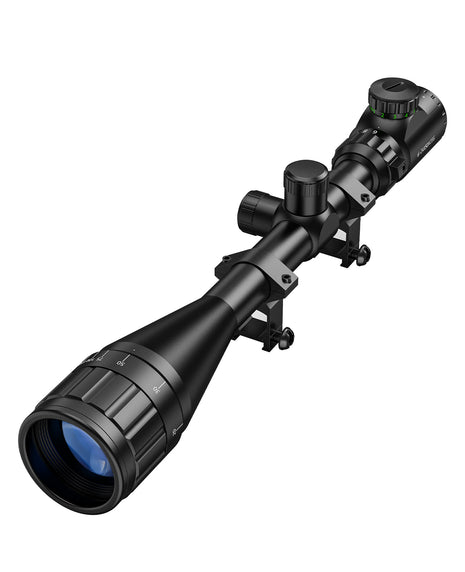
- Variable-magnification (e.g., 3-9x40): range flexibility at the cost of mechanical complexity. For most 2026 hunting applications, a 3‑9x or 4‑12x variable is the all-around workhorse.
LPVO
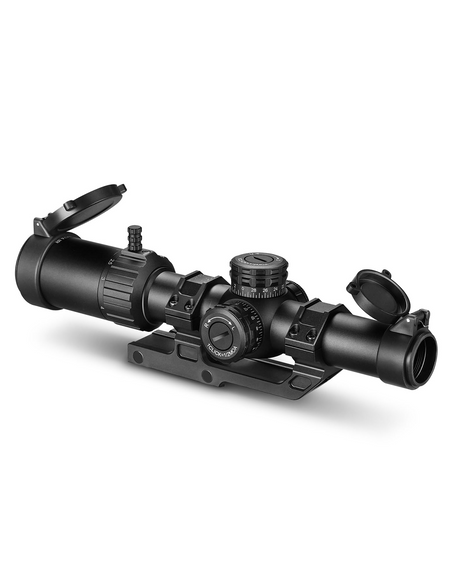
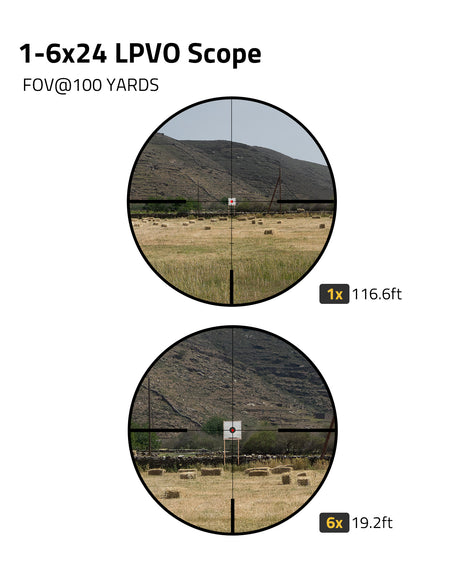
A 1‑6x or 1‑8x LPVO behaves like a red dot at 1x (fast, both-eyes-open acquisition) and provides enough magnification for medium-range shots at 6x or 8x. Default choice for 3-Gun, AR-platform hunting, and home-defense rifles.
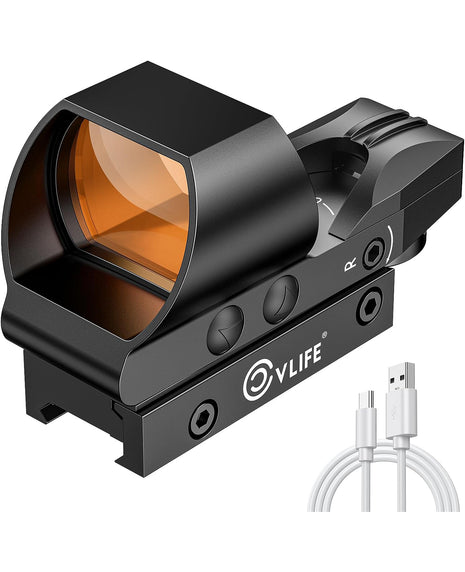
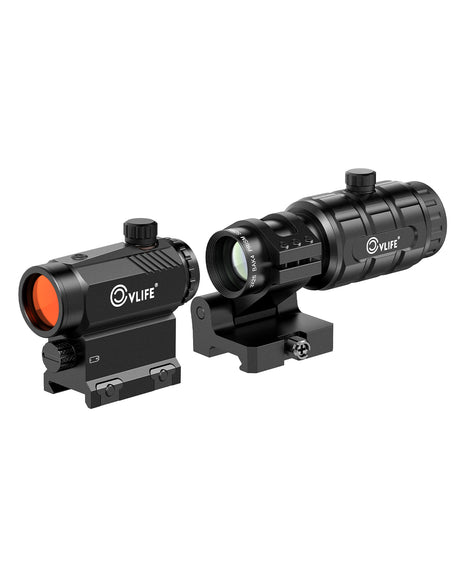
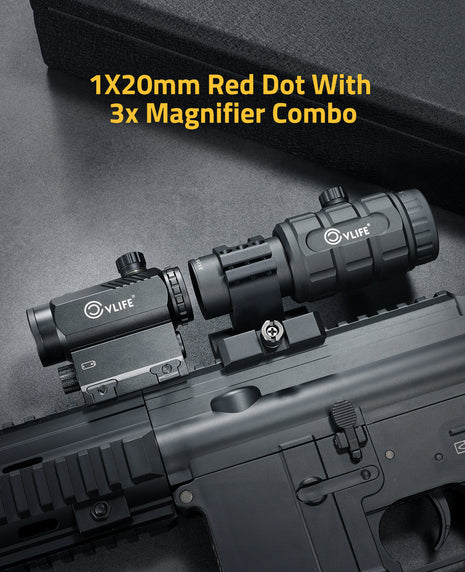
Red dot + magnifier
For AR-platform hunters who want modular flexibility, pair a red dot with a flip-to-side EagleFeather 3x magnifier. Trade-off: heavier, longer, magnifier is offset when not in use.
FFP vs SFP
- SFP (Second Focal Plane): Reticle stays the same physical size. Holdovers only accurate at one magnification. Most hunting scopes are SFP.
- FFP (First Focal Plane): Reticle scales with magnification. Holdovers accurate at any magnification. Preferred by long-range and military users.
For most hunting, SFP is fine and typically cheaper. If you shoot at varying distances and need quick holdovers, FFP is worth the premium.
Illuminated reticle
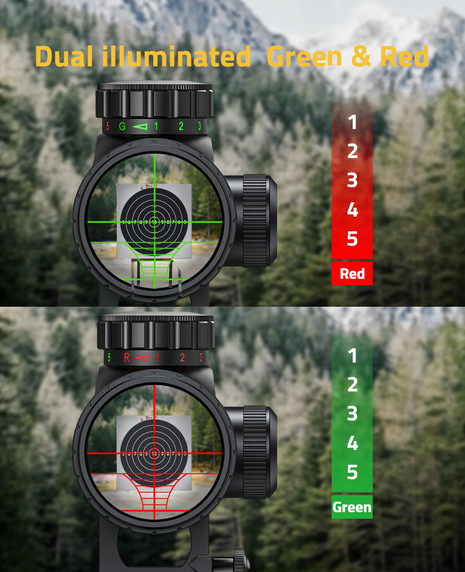
Illuminated reticles (red/green dot at center) help in low-light hunting and against dark backgrounds. They do not improve accuracy — they improve target acquisition speed.
05Mounting, rings, and the system
Mounting is the most overlooked part of an optic purchase.
| Ring height | Range | Typical use |
|---|---|---|
| Low | 0.5"–0.75" | Flat-top ARs, similar platforms |
| Medium | 0.87"–1.0" | Most bolt actions, standard-diameter scopes |
| High | 1.0"–1.25" | Large-objective scopes (50 mm+) on bolt actions |
| Extra-high | 1.5"+ | Objectives over 56 mm, or with sunshades |
Material
- Steel — strongest, heaviest. Standard for magnum-recoil rifles.
- Aircraft-grade aluminum — light, strong enough for most cartridges. Standard for AR-platform.
- Titanium — premium, light, strong. Overkill for most applications.
Most ring manufacturers specify torque in inch-pounds, not “snug.” A 1/2" drive torque wrench with an in-lb scale is the right tool. Under-torquing lets the scope shift; over-torquing can crack the scope tube. For base screws, the Picatinny rail spec is published publicly — worth a careful read.
The optic is part of a system, and the system is only as strong as its weakest component. A cheap scope mounted correctly will out-perform an expensive scope mounted sloppily — a measurement result we have repeated many times in our own testing.
06Frequently asked questions
Direct answers to the questions we hear most often.
What magnification do I need for deer hunting?
3-9x or 4-12x covers most whitetail and mule deer shots under 300 yards. Push to 4-16x or 6-24x for open country past 400 yards. A 1-6x LPVO suits AR-platform hunters who want fast close-range capability.
Is ED glass really worth the premium?
ED glass matters most at the long end of your magnification range and at long distances. A 6-24x at 24x past 400 yards shows a visible benefit.
Red dot or scope?
Red dot for close-range, fast acquisition (under 100 yards). Scope for target identification, holdover judgment, and distance. Many hunters combine both with a flip-to-side magnifier.