Magnification vs. Field of View: What Actually Improves Hunting Accuracy?
7 min reading time
Hunters constantly weigh two scope attributes: magnification for distant precision, and field of view (FOV) for rapid, situational awareness. The industry often pushes higher magnification as the ultimate accuracy booster, but optical physics and field experience tell a more nuanced story. This guide breaks down the real trade-offs and provides a clear, structured path to selecting what matters for your hunt.
Magnification: Precision with Compromises
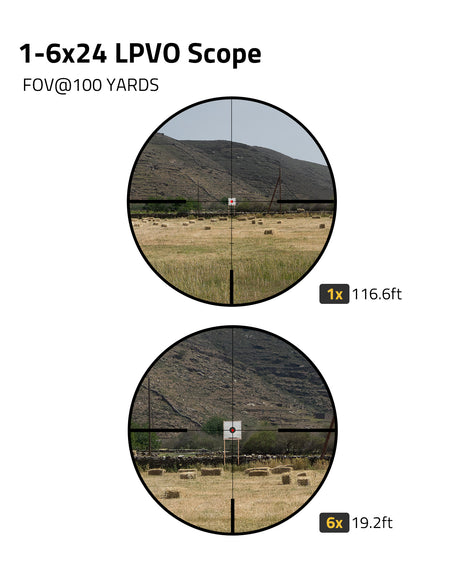
More magnification makes a target appear closer, aiding shot placement on small vitals. It's undeniably useful in open terrain or for trophy judging. However, increasing magnification directly reduces FOV and exit pupil.
Advantages: finer aiming point, better target identification at range, confidence on distant shots.
Compromises: narrow FOV makes tracking moving game difficult; tiny exit pupil dims the image in low light; mirage and wobble are amplified.
Field of View: Speed and Awareness
A generous FOV (measured in feet at 100 yards) keeps you connected to the environment. It enables both-eyes-open shooting, faster target acquisition, and better tracking—critical in timber, brush, or driven hunts.
Trade-off: at extended distances, fine detail and precise holdover become more challenging without sufficient magnification.
Optical Physics in a Nutshell
Exit pupil = objective lens diameter ÷ magnification. Human pupils dilate to roughly 5–7 mm in low light. When the scope’s exit pupil falls below ~4 mm, the image appears dim. The twilight factor (√(mag × obj)) hints at resolution, but it can't compensate for a starved exit pupil. The sweet spot for hunting scopes keeps exit pupil between 4 mm and 7 mm during legal shooting hours.
Matching the Optic to the Environment
Hunting Scenario
Typical Range
Priority
Ideal Optic
Dense woods / brush
20–100 yd
Wide FOV
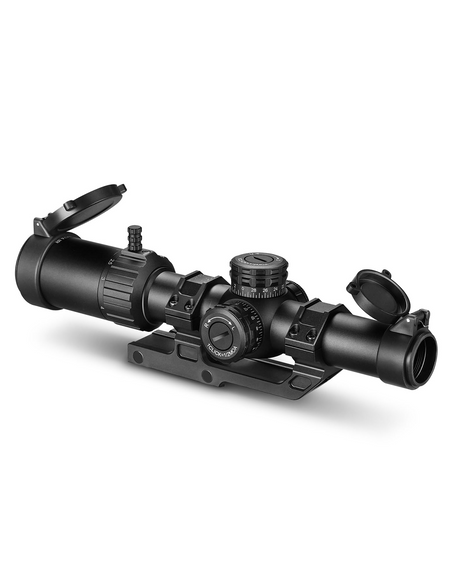
1–6× or 1–8× LPVO
Mixed farmland edges
50–250 yd
Balanced
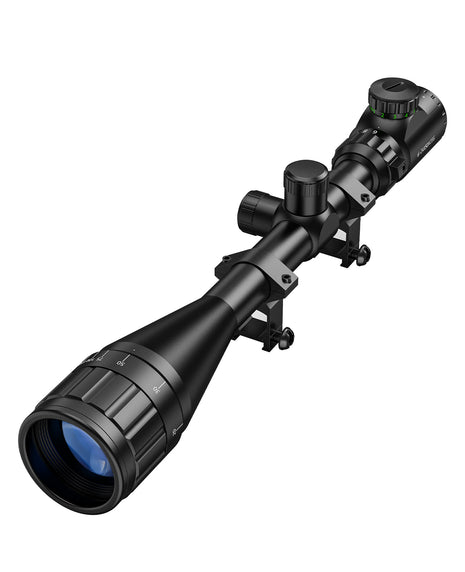
2–10× or 3–15×
Open plains / mountains
200–500+ yd
Higher magnification
4–20× or 5–25×
Driven hunts / hog control
Under 75 yd
Maximum FOV, speed
True 1× LPVO
3-Step Decision Framework
Define your primary distance & cover. If 80% of shots are inside 150 yd in timber, prioritize wide FOV over high magnification.
Calculate minimum exit pupil. Keep magnification such that (objective / mag) ≥ 4 mm during shooting light. Example: a 24mm objective at 6× gives 4mm, still acceptable.
Test both-eyes-open at 1×. If the scope causes double vision or delay, it may be not a true 1×. Consistent eye relief and a flat image are key.
Frequently Asked Questions
Is higher magnification always better for accuracy?
No. While it reveals detail, it shrinks FOV and exit pupil. Accuracy also depends on stability and reticle alignment. Many hunters shoot precisely at 4–8× even beyond 300 yards.
What magnification is ideal for dense woods deer hunting?
A 1–6×24 or 2–7×32. The low end provides quick acquisition in thick cover; the upper end handles clearings out to 200 yards.
How does exit pupil impact low‑light performance?
Exit pupil controls light delivery. If the scope's exit pupil is smaller than your dilated pupil, the image dims. Maintaining ≥4mm exit pupil dramatically improves dawn/dusk clarity.
Can a 1–6× LPVO replace a dedicated long‑range scope?
For hunting inside 400 yards, absolutely—especially with a BDC reticle. Beyond that, specialized high‑magnification optics have the edge.
👤
CVLIFE Optics Team
Specializing in optics evaluation, outdoor gear R&D, and practical shooting education. We combine decades of field experience with optical engineering to deliver data‑driven guidance.