Product Analysis · No. 01 · CVLIFE EagleTalon 1-6x24 LPVO
CVLIFE EagleTalon 1-6x24: The Scope That Holds Zero
Sixteen spec lines, eight buyer questions, and the two numbers that stop working on a .308.
Why this scope exists, and who it is for
Before the specifications, the problem the design answers.
An LPVO — low power variable optic — is a riflescope whose magnification starts at true 1x and tops out between 4x and 10x. The format exists because most rifles have to do two jobs that used to need two optics: a close, fast, both-eyes-open sight picture at 1x, and enough magnification to place a shot at a few hundred yards. A red dot handles the first job well and the second badly. A fixed 3-9 handles the second and fails the first. A 1-6x24 does both adequately, which is why it became the default general-purpose carbine optic in the US market.
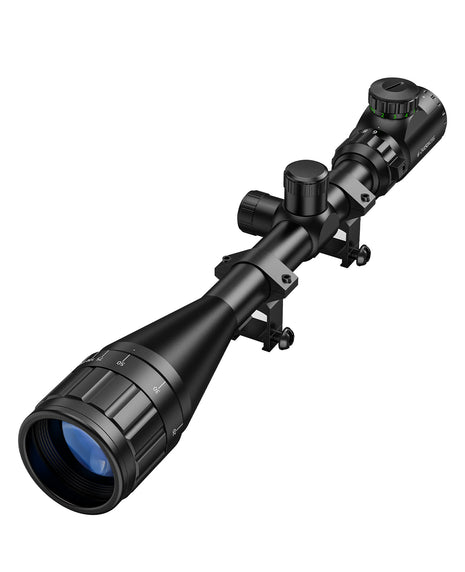
The CVLIFE EagleTalon 1-6x24 is CVLIFE's entry into that format, and its brief is visible in the spec sheet: true 1x to 6x, a 24 mm objective to keep the scope short and mountable low, an etched BDC reticle that works without batteries, exposed locking turrets, and a 30 mm cantilever shipped in the same box so the buyer does not have to solve the mount question separately. The bundle is not generosity; it acknowledges that most first-time LPVO buyers get the mounting step wrong.
Three buyers are served here, and the specification tells you which one you are. The first is putting a first variable optic on a 5.56 carbine and wants the whole setup in one order. The second is a hunter working timber and field edges who needs clean glass and usable holdover without spending four figures. The third already owns good rifles and wants a cheap optic that will not embarrass itself on a loaner gun. The buyer this scope fails is the .308 hunter — documented, specific, and explained below.
The format: three numbers and one promise
"1-6x24" is not a model code. It is three specifications, and each one is a decision.
The 1x floor is the promise. At minimum power the scope is meant to be used the way a dot sight is used: both eyes open, target focused, nothing to manage. That only works if the optics are genuinely 1x rather than approximately 1x, and only if the eyebox is forgiving enough that the shooter does not hunt for it. Owners describe this scope's eyepiece as falling naturally into view, which is the property that turns a spec into a working 1x.
The 6x ceiling is the work. Six times identifies a target at 300 yards and makes a BDC meaningful, and it is not a precision instrument. Anything above 6x in this tube size costs light or money or both, which is why the 1-8x and 1-10x versions of the same family sit in a different price conversation.
The 24 mm objective is the compromise. It caps light gathering at a level that matters at dusk and fails at night, and in exchange keeps the scope under 11 inches, light enough for a carbine, and low enough to mount for a natural cheek weld. Every other decision in this scope follows from those three numbers.
Sixteen spec lines, and what each buys
The first four decide whether it fits the rifle; the next eight describe behaviour; the last four are pack and paperwork.
| Specification | EagleTalon 1-6x24 (BDC-I) | What this number actually decides |
|---|---|---|
| Magnification | 1–6x | The usable window: true 1x for close speed, 6x for the BDC and detail |
| Objective | 24 mm | Light gathering ceiling and the entire size of the scope |
| Tube | 30 mm | Mount compatibility, internal adjustment range, and weight |
| Focal plane | SFP | Reticle subtension stays fixed — so the BDC is calibrated at 6x only |
| Reticle | BDC-I / BDC-II, etched glass, SFP | Holdover scheme and how cleanly it reads against dark or busy ground |
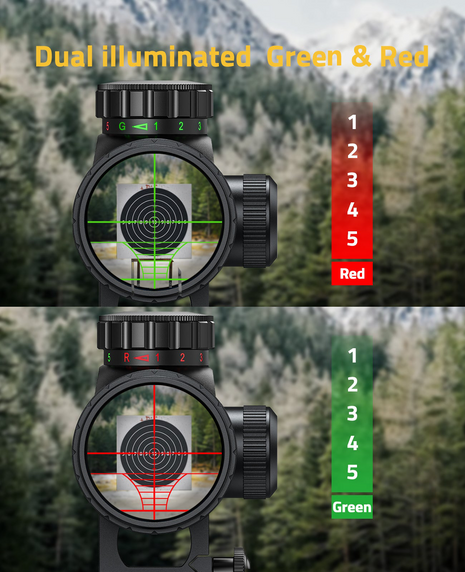
| Illumination | Red centre, 6 levels + off between each | Low-light pickup; explicitly not daylight brightness |
| Turrets | Exposed locking, zero reset, brass internals | Whether you can dial fast without losing the setting, and whether the clicks count |
| Click value | 1/2 MOA | Resolution of adjustment; fine for this class, coarse for precision work |
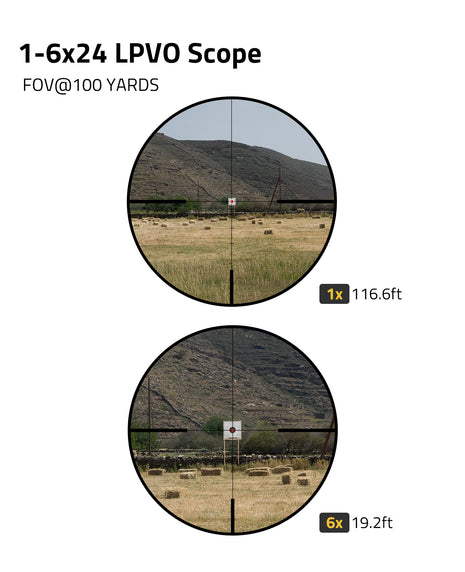
| Field of view | 116.6 ft @1x / 19.2 ft @6x (per 100 yd) | How much ground sits in the window at each end |
| Product dimensions | 10.5 x 2.76 x 1.96 in | Rail space and case fit. This is the scope, not the carton |
| Weight | 24.3 oz | Balance on the rifle; mount and body together |
| Eye relief | Just over 2 in at 6x (owner measured) | Whether a heavier cartridge will reach your eyebrow |
| Material / finish | Aluminum, black hard-anodized matte | One-piece tube rigidity and how the finish survives a truck bed |
| Water / sealing | IPX7 | Nitrogen purge and O-ring seals; immersion safe, dust ingress not stated |
| Coating | Fully multi-coated, all surfaces | Contrast in poor light and flare resistance near the sun |
| Included mount | 30 mm cantilever, 1.40 in ring centre | Whether the sight line matches the stock without adding a riser |
What ships in the box — all eight items
A bundle is only worth something if the parts are the ones a first setup actually needs.
| Contents | Qty | Why it is in the box |
|---|---|---|
| Scope body | 1 | The 1-6x24 LPVO itself, 30 mm one-piece aluminum tube |
| 30 mm cantilever mount | 1 | Pushes the eyepiece forward over the receiver so eye relief works on an AR rail |
| Detachable throw lever | 1 | Faster magnification changes without leaving the firing position |
| CR2032 cells | 2 | Illumination power; two cells means a spare ships with the scope |
| Scope caps | 2 | Keeps both lens surfaces clean between sessions |
| Cleaning cloth | 1 | Clear dust first, then wipe — the step that protects the coating |
| Allen key | 1 | For the mount's ring and base fasteners |
| Manual | 1 | The reticle's actual MOA dimensions live here |
This is the part most reviews skip, and it is where first-setup cost is decided. Buying the same scope, mount, throw lever, caps, key and cells as separate line items typically adds $25 to $40 to a $99.99 optic. Whether the included mount is the right height is a separate question — answered below — but its presence is a genuine saving.
How it behaves once it is mounted
Four behaviours, in the order a new owner meets them.
The 1x end is a sight picture, not a dot
At 1x this scope delivers a wide field and a fast acquisition window, and it does not deliver a floating reticle with unlimited eye position. It is still a tube: the eye has to sit inside the eyebox at the right distance. Owners describe the eyepiece as falling naturally into view. Buyers who want dot behaviour at 1x are buying the wrong shape of optic, and no amount of time behind this one changes that.
The BDC is a 6x tool, and the manual says so
Second focal plane means the reticle's angular subtension stays constant in the lens plane while the image grows with magnification. The mechanical result: the BDC-I stadia are calibrated at 6x. Dial to 3x for speed and the same holdover marks now represent roughly double the real drop, so a shooter holding the 300-yard line is aiming over the target.
The turrets are the quiet strength
Exposed locking turrets with zero reset, 1/2 MOA per click, detents that can be heard as well as felt, brass internals, and a lift-to-turn gate. Hunters who dial for range and service-rifle shooters who click for wind report the same thing: the clicks are distinct enough to count without looking. On a $100-class optic this is the least common thing to get right, and the reports hold up across several buyers and several years.
Held zero is the number that decides value
Across the owner reports, the repeated finding is not glass or reticle design but that the group stays where it started. A five-shot ragged hole at 50 yards, one inch at 100, a two-inch spread at 200 on the same zero — that is a working carbine optic.
The mount height question, answered once
The included cantilever measures 1.40 in from ring centre to the top of the rail. That is a real number and it sits on the low side of the AR norm, which is why it gets its own paragraph instead of a footnote.
At 1.40 in, a shooter on a standard carbine stock with a high comb can find the sight line slightly below the natural cheek position, which drops the eye and shortens effective eye relief. The correction is cheap — a small riser or a taller mount — but it should be planned rather than discovered at the range. The included mount still saves money over buying one separately; it simply does not guarantee the right height for every rifle.
What it is worth in its price band
The score and the price sit next to each other on purpose: neither means anything alone.
| Consideration | EagleTalon position | Why it lands here |
|---|---|---|
| Scope plus mount plus small parts | $99.99–$129.99 | It exists before any holiday pricing |
| Separate-parts equivalent | +$25–$40 | Mount, throw lever, caps, cells and key bought as line items |
| Illumination ceiling | Below daylight | The one place money does not buy a fix in this class; a daylight-bright dot is a different product category |
| Eye relief on heavy cartridges | Just over 2 in at 6x | Workable on 5.56, may be biting on .308 — a format decision, not a build defect |
| Weight | 24.3–24.8 oz | Neutral on a full-size carbine, noticeable on a lightweight build |
| Weighted score | 8.1 / 10 | Ten criteria, weighted for a general-purpose 5.56 carbine role |
The comparison that matters is not against a $400 optic — a $400 optic wins on glass, and it should. It is against the cost of doing this job with two devices: a dot for the close shot and a fixed scope for the far one, plus two mounts, plus two zero sessions.
Weighted scorecard
Weights reflect how much each criterion affects the first 500 rounds in a general-purpose 5.56 carbine role. They shift for a dedicated hunting rifle or a precision build.
Etched BDC-I is uncluttered and legible on paper at 100 and 200 yards in multiple owner reports.
Six levels, none daylight-visible. Fine in timber and low light; not a dot replacement for brightness.
Exposed locking, zero reset, audible and tactile 1/2 MOA clicks, brass internals, lift-to-turn gate.
Repeatable 50/100/200 yd groups across several buys; 1,500-round 5.56 carry-zero claim published.
Just over 2 in at 6x suits light recoil.
Scope, 30 mm cantilever, throw lever, two cells, caps, cloth, key and manual.
1.40 in ring centre works on an AR but sits below the 1.50 in norm; may need a riser on a high comb.
24.3 to 24.8 oz measured. Neutral on a full-size carbine, top-heavy on a lightweight build.
IPX7 immersion, nitrogen purge, O-ring seals, hard-anodized finish; dust rating not stated.
A published review was updated after the manufacturer contacted the buyer and addressed the concern.
Weighted across these ten criteria the scope lands at 8.1. The two soft spots — illumination ceiling and eye relief on heavier cartridges — are format limits as much as product limits. The strong points are the bundle, the turret feel, the held-zero reports, and a support response that shows up in a public review thread.
Five configurations behind one product page
Reticle style first, magnification second — in that order, because that is the order the page asks for.
| Reticle style | Magnifications | Who this pairing is for |
|---|---|---|
| BDC-I | 1-6x24 only | The default read in this article: one etched holdover scheme, one magnification, no decisions left open |
| BDC-II | 1-4x24 | Short-range carbine where 4x is plenty and a lighter build matters |
| BDC-II | 1-6x24 | The same window as BDC-I with a different holdover scheme — compare the two reticle diagrams before choosing |
| BDC-II | 1-8x24 | Reaching further on the same 24 mm tube; expect the light budget to tighten at 8x |
| BDC-II | 1-10x24 | Longer glass in the same family — a different optic from the 1-6x24 read here |
Where this format stops being the right answer
This format suits
- A 5.56 carbine covering a room and a few hundred yards with one optic
- A first variable optic where the mount and small parts arrive with the scope
- Timber, dawn and indoor use, where six illumination levels are enough
This format does not suit
- A heavy host — eye relief becomes the binding constraint
- Last-light hunting that needs light gathering past a 24 mm objective
- Precision paper at 300+ where 1/2 MOA clicks and 6x are both too coarse
- A sub-20 oz build, or a stock comb that needs a taller sight line
Two reference points, kept short
No links to either, and no verdict on either — they are here to calibrate what the numbers above mean.
| Reference | What it shows about the format |
|---|---|
| Monstrum Banshee HD 1-6x24 | Same magnification, objective, tube and SFP architecture, offered with a reticle menu instead of one etched design — useful for seeing what a holdover-scheme choice is worth to a buyer. |
| Firefield RapidStrike 1-6x24 | Same format in a shorter, lighter body with a full IP67 dust-and-immersion rating — useful for seeing what weight and sealing cost when a rifle lives outdoors. |
All three come down to the same three questions: does the mount height match the stock, how bright does the reticle actually get, and what cartridge is going to sit behind it. Those answers decide the optic more than the badge does.
The questions buyers actually ask
Eight answers, in the order the questions arrive — pack contents first, paperwork last.
What comes in the box?
The BDC-I / 1-6x24 kit holds the scope body, a 30 mm cantilever mount, one detachable throw lever, two CR2032 cells, two scope caps, a cleaning cloth, an Allen key and a manual. Pack contents follow the configuration you bought, so confirm the cart line before checkout rather than after delivery.
Can BDC-I be bought in any magnification?
No. BDC-I exists only as 1-6x24. BDC-II covers the other four pairings — 1-4x24, 1-6x24, 1-8x24 and 1-10x24 — and all five sit on one product page. That is precisely why the reticle style and the magnification have to be confirmed together; picking one and assuming the other is how buyers end up with a 1-10x24 when they meant to read about a 1-6x24.
Does the BDC work at every power?
It does not, and that is the format talking rather than a shortcoming of this scope. Second focal plane keeps the reticle's angular size fixed while the image grows, so the BDC-I stadia are calibrated at 6x. At 3x the same marks stand for roughly double the real drop. Dial to 6x whenever the holdover lines are doing the work, and dim down only for speed.
Is the BDC accurate for any ammunition?
The 20–600 yd reference range is stated for .223/5.56 and .308/7.62 generally. What the marks actually correspond to depends on bullet weight, muzzle velocity and the zero distance, so treat them as a starting reference and confirm them on paper at the ranges you shoot.
How do the illumination settings work?
Six red levels for the centre reticle with an off position between each, so stepping through brightness never passes through a lit detent. It runs on the CR2032 cells in the box, and it is a reticle visibility aid rather than a night-vision function.
How do I reach support?
Configuration, manual, shipping and after-sales questions go through the CVLIFE support center or support@cvlife.com. The track record here is unusually visible: one verified buyer's critical review of this exact scope was updated after support contacted them about the concern, which is more useful than a satisfaction percentage.
Buying it in the holiday window
Entry-level LPVOs and the mounts that pair with them discount hardest in the last week of November. The main Black Friday date in 2026 falls on Friday, November 27.
And all five variants share one page, so a discount on the wrong magnification is a return rather than a deal. The other magnifications in the family are listed in the LPVO collection, and range procedure is covered in the NSSF shooting safety material.