
Featured collection
-
-
$159.99 $136.79
-
-
$59.99

Crossbows and rifles have different trajectories — arrows drop far more than bullets, so crossbow scopes aren't just rifle scopes on a bow. A dedicated crossbow scope needs moderate magnification (1.5-5× or 2-7×), a reticle with built-in holdover marks for distances like 20-50 yards, parallax fixed around 30 yards, and shock resistance for string vibration — higher magnification hurts more than it helps. Speed-adjustable scopes (300-460 FPS) let you calibrate for your bow. A universal riflescope can mount on a crossbow, but parallax set at 100 yards causes errors at 30-50 yards, and you'll do mental math for holdover. Bottom line: a proper crossbow scope keeps you accurate from 20 to 80 yards — pick one built for the job.
Crossbows and rifles have one fundamental difference when it comes to shooting: arrows fly much slower than bullets, and they drop a whole lot more.
A .308 rifle drops only a few inches at 300 yards. A crossbow bolt can drop over 10 inches at just 50 yards. That difference changes everything — rifle scopes and crossbow scopes are not the same thing.
This article isn't about rifles. It's about crossbow optics. Why you need a dedicated crossbow scope. How to pick one. What magnification works. What the reticle should look like. By the end, you'll know exactly what to look for.
 What Makes a Crossbow Scope Different?
A crossbow's trajectory shapes its scope in four specific ways — all different from rifle scopes.
First, you don't need high magnification. Crossbows are effective inside 100 yards, with most shots falling between 30 and 60 yards. At those distances, 2-6× or 1.5-5× is plenty. Experienced crossbow hunters will tell you that more magnification actually hurts — it narrows your field of view, adds weight, and slows you down when you need to acquire a target quickly at close range.
Second, the reticle comes with built-in holdover points. This is the core feature of a dedicated crossbow scope. A standard riflescope gives you a simple crosshair. A crossbow scope gives you a vertical stack of dots or hash marks — each one corresponding to a specific distance: 20, 30, 40, 50 yards, all the way out to 100. You don't guess how much to hold over. You just pick the dot that matches your range and put it on the target.
Third, parallax is usually fixed around 30 yards. Because crossbow shots stay relatively short, most dedicated crossbow scopes have their parallax set at 30 yards — not adjustable like a rifle scope.
Fourth, shock resistance is different. Crossbows don't have the explosive recoil of a rifle, but they do have string vibration. The overall shock is much lighter, but repeated vibration can still shake a cheap scope loose inside. A solid crossbow scope should still be shock-rated — the CVLIFE 1.5-5x32, for example, is rated for 1000G impact.
Magnification: How Much Do You Really Need?
Common crossbow scope magnifications run 1.5-5×, 2-7×, or 3-9×, with objective lenses usually between 32mm and 40mm. The rule is simple: low end should be low enough for fast target acquisition. High end doesn't need to be very high, because your effective range is limited anyway.
A 1.5-5×32 is a great all-around choice. At 1.5×, you get a wide field of view for thick brush or close-range shots. At 5×, you can easily see and aim at targets 50-80 yards out. If you mostly hunt open terrain or shoot at the range, a 3-9× configuration can also work — it gives you finer aiming reference points at the high end, and it's still perfectly usable on a crossbow.
The Reticle: Readability Is Everything
A crossbow scope's reticle makes or breaks the experience.
A good one labels distances right on the glass — 20, 30, 40, 50, 60, 70, 80, 90, 100. You range your target, pick the corresponding dot, and aim. No mental math. No guessing holdover. Just point and shoot.
Since bolt speed varies from one crossbow to another, some scopes offer speed adjustment (typically 250-450 FPS) so you can calibrate the reticle to your specific crossbow's velocity.
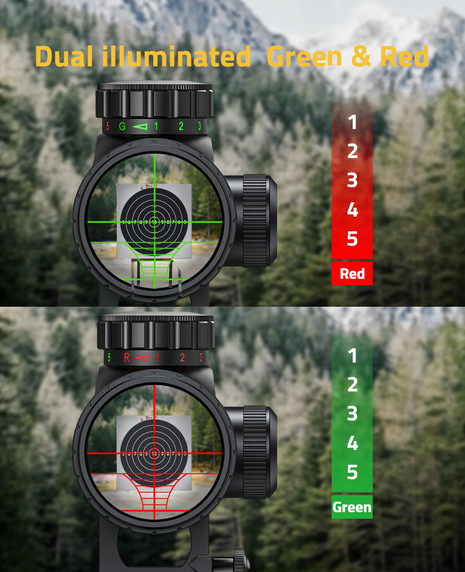
Low-light illumination matters too. Red and green multi-level illumination keeps the reticle visible at dawn and dusk — when the big bucks are most active.
Rings and Mounting
Most crossbows have a 20mm Picatinny rail above the barrel. Most crossbow scopes come with matching rings right in the box — no extra shopping required.
Two things to check when mounting: tube diameter must match — common crossbow scopes use 30mm tubes, but some older models use 1 inch. Rings aren't interchangeable, so check before you buy. Ring height should be appropriate — with a 32mm objective, you don't need high rings. Low or medium rings work just fine.
Dedicated Crossbow Scope vs. Universal Variable Scope
Can you put a 3-9×40 rifle scope on a crossbow?
Yes. But that doesn't mean you should.
A universal scope usually doesn't have bolt-drop compensation marks. You'd have to memorize conversions — "that 200-yard mil-dot equals my 40-yard hold" — which is doable, but far from intuitive. Also, most rifle scopes have parallax set at 100 yards. At 30-50 yards, that introduces aiming error. If you're serious about crossbow hunting, spending a little on a dedicated crossbow scope saves you headaches and makes you more accurate.
The Bottom Line
A crossbow scope isn't just a riflescope bolted onto a crossbow. It needs moderate magnification, a reticle with built-in bolt-drop compensation, parallax suited for short ranges, and a compact, lightweight build. Get it right, and you'll be fast and accurate from 30 to 80 yards.
$159.99 $136.79
$59.99


