Product Analysis · No. 02 · CVLIFE FoxSpook 1x28x40mm
CVLIFE FoxSpook 1x28x40mm: The Open Sight With Four Reticles
A plain-English guide to what a 1x open reflex sight actually does, why a large window and a switchable reticle matter more than a long spec sheet, and which details are worth confirming before this type of optic goes on your rifle.
Why this sight exists, and the one decision that matters
Before the specifications, the thing that separates it from the shelf.
A 1x open reflex sight at around $56 is not a difficult product to make. An aluminium housing, a coated reflector, a red LED, a cell somewhere in the body, and a base that clamps a 20 mm rail — nearly every sight in this price band has all of it. So the useful question is not what the FoxSpook has. It is which of its decisions a buyer will notice after the first month, and there are two.
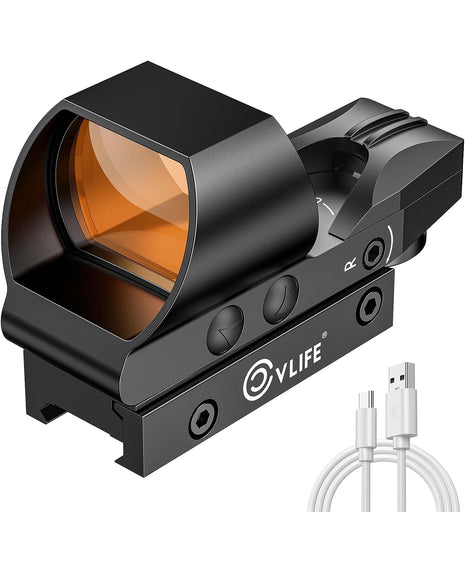
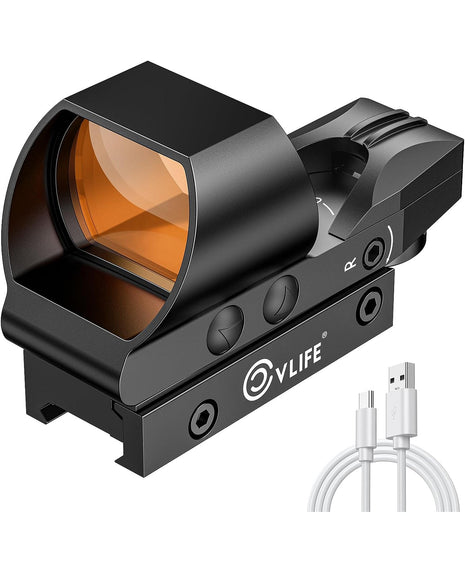
The first is four reticles in one housing. Most entry-level sights make you choose a dot size at checkout and then live with it. This one switches between a plain dot, a circle with a dot, a crosshair with a dot, and a crosshair with both circle and dot. That is four different ways of finding the same aiming point, on the sight rather than in the shopping cart. At this price it is genuinely unusual, and it is the reason the product exists.
The second is the integrated absolute co-witness base. The sight arrives on a standard-profile 20 mm Picatinny mount with a 0.15 in metal lock bar, at a height intended to let the dot and the rifle's iron sights share one plane. For a buyer adding a first optic to a rifle that already has irons, that removes a riser, an extra part number, and one decision about cheek weld.
Three buyers are served here. The first is putting an inexpensive first dot on a .22 or a pistol-calibre carbine. The second is running a rifle with iron sights and wants a visible backup. The third is fitting out an airsoft or paintball platform where a sealed, duty-grade tube would be wasted money. The buyer this sight does not serve is anyone mounting on a reciprocating pistol slide, anyone who needs a stated weather rating, and anyone who needs magnification for target identification. Those are category boundaries, not faults — and knowing them in advance is the whole point of a guide like this one.
What remains is a genuinely useful combination: a large window, a reticle you can change to suit the work, eight brightness levels, and a base that is ready to clamp out of the box. The product page is the place to see the four colour options together.
What an open reflex sight is, and how this type differs from a tube red dot
The category explanation first, because the specification only makes sense once the shape does.
An open sight — also called a tubeless or open red dot — has no tube. A small LED projects a red reticle onto a single coated lens, and you look straight through that lens at the target with both eyes open. There is no front glass, no rear glass, and no eyepiece to line up. That is why the FoxSpook's window can be 28 × 40 mm: the whole aperture is available to your eye instead of being the diameter of a tube.
The alternative is a closed tube red dot, of which the Bushnell Trophy TRS-25 is the familiar example. It sandwiches the emitter between two lenses inside a sealed body, which is why that type can carry an O-ring, a nitrogen purge and an IPX5 rating. The trade is a smaller 20 mm-class window and, in most cases, one fixed dot rather than a set of switchable patterns. Neither shape is better in the abstract. A sealed tube is the right answer when weather exposure is the defining condition; an open reflector is the right answer when a wide, fast sight picture is.
Three properties follow from the open, 1x, parallax-corrected design, and they define what this type of optic is for:
- 1x with no magnification. You are placing a reticle on a target you have already identified, not identifying one at distance. A placing tool, not an observation tool.
- Parallax corrected. The manufacturer's wording means the reticle stays on the point of aim even when your eye is not perfectly centred behind the lens. Combined with unlimited eye relief, mount position becomes a comfort choice.
- A large window. The dot stays visible through a wider range of head positions, so an imperfect cheek weld costs you far less than it would through a magnified scope or a small tube.
Layered on top of those is absolute co-witness: the sight sits at a height intended to put the dot in the same visual plane as the rifle's iron sights, so both can be used without changing your hold. The official copy states absolute co-witness; the ~1.45 in centre height you will see quoted comes from channel material rather than the official spec table, so whether it lines up on your particular rifle is a measurement to confirm on the gun.
Eighteen published lines, and what each one decides
Read in four groups: what it is, how it aims, what survives, and what runs and adjusts.
| Group | Line | Published value | What it decides |
|---|---|---|---|
| What it is | Magnification | 1x | Fast, both-eyes-open use; no target identification |
| Window / objective | 28 × 40 mm | How forgiving the sight picture is off-axis; official spec table figure | |
| Reticle options | 4 | Dot / Circle-Dot / Crosshair-Dot / Crosshair-Circle-Dot | |
| Reticle colour | Red | The only colour published; no green option | |
| Lens coating | Fully multi-coated | Clarity and light transmission; an anti-fog coating is also claimed | |
| How it aims | Parallax | Parallax corrected | Manufacturer wording |
| Eye relief | Unlimited | Mount position is a comfort choice, not a requirement | |
| Field of view | 15.8 m @ 100 m | Official figure | |
| Click value | 1 MOA | About one inch at 100 yd; the category default | |
| Co-witness | Absolute | About 1.45 in centre height per channel material | |
| What survives | Housing | Aluminium, Black Matte | Weight and how the base clamps; finish stated for the Black variant |
| Shock claim | up to 800G | A manufacturer claim | |
| Water / dust rating | Not stated | Only an anti-fog coating is claimed; an open reflector makes no sealing claim | |
| What runs and adjusts | Brightness | 8 levels | Short press to cycle, from daylight toward dusk |
| Shutoff | Hold ~3 s, manual | Simple and predictable; no auto-off or motion wake is claimed | |
| Battery | Not stated | Cells are supplied, but the type and runtime are not published; confirm in the manual | |
| Mount | 20 mm Picatinny, integrated | 0.15 in lock bar; standard profile, not quick detach | |
| Weight | about 5.3 oz / 152.5 g | Light on a rifle; three near-identical published figures |
Figures quoted from the CVLIFE product page and its published product data, retrieved 2026-11-19. Channel-only figures are labelled as such in the text. The $55.99 price is the Black variant, not the page's "from" price.
Four of those eighteen change the shooting experience on the first session: the reticle set, the window, the eight brightness levels, and the co-witness base. The two lines marked "not stated" are not defects; they are simply the two things to confirm before you order, which is what the next section is for.
What the four reticles actually buy
Four ways of finding one aiming point, and the switch you operate yourself.
One dot, four ways of finding it
A plain dot is the cleanest sight picture and the slowest to pick up against a busy background. A circle-dot gives the eye a large shape to find first, then a precise point inside it. A crosshair-dot adds horizontal and vertical references that help with a rough hold. The fourth pattern combines all three. None of them is more accurate than another — the turrets move the same 1 MOA per click whichever shape is lit — but they are not equally fast under pressure, and the ability to change them on the sight rather than by buying a different optic is the product's real value.
All four are red, with no green option and no night-vision or IR setting.
Eight brightness levels, and a switch you control
A short press turns the sight on and cycles the eight levels; a press of about three seconds turns it off. That is the whole power-management story, and for a sight at this price it is arguably a virtue: there is no sleep timer to behave unexpectedly and no motion sensor to depend on. One owner review makes the point in capital letters — "DOES NOT 'Shake Awake!'" — while the same owner reports the sight "remained true after 100+ rounds" on a .22 rifle.
The practical consequence is a habit rather than a specification: switch it off when you put the rifle away, and take the cells out for long storage. Do that and the absence of an automatic mode never costs you anything.
1 MOA clicks and a 0.15 in lock bar
One click moves the point of impact roughly one inch at 100 yd — the category default, neither finer nor coarser than the competition in this guide. Windage and elevation screws are adjusted with the included hex tools; a third-party review places elevation on top, windage on the left, and a smaller locking screw on the right of the base. That lock bar and those screws are where zero retention is actually decided, which is why a correctly seated base matters more than any shock rating on the box.
What owners actually report
The specifications describe the product. These patterns describe what it is like to live with.
Publicly available buyer feedback on this sight clusters around a short list. Value for money is the most-mentioned theme — 57 mentions, 51 of them positive — and functionality is a close second at 56 mentions, 48 positive. Those are recurring themes in owner accounts rather than a statistical survey, but the direction is consistent enough to be useful.
| What is reported | Frequency | How to read it |
|---|---|---|
| Value for money | 57 mentions (51 positive / 6 negative) | The dominant theme. Owners repeatedly describe it as performing above its price tier |
| Functionality, clarity and easy sighting-in | 56 mentions (48 positive / 8 negative) | "Clear", "easy to mount" and "easy to sight in" recur; .22 rifles and 9 mm carbines come up often |
| Sturdy build and a hard case | Commonly positive | A hard case, lens cloth, adjusting tools and two sets of cells appear in owner accounts |
| No motion wake | Explicit, at least one owner | Consistent with the product page, which describes only a manual three-second shutoff |
The zero-retention pattern is the useful one. Where an owner reports a wandering zero, the cause in most accounts is the interface — a clamp not seated in the rail slots, a fastener at the wrong torque, a rail that was not flat. The 800G figure describes the housing after an impact, not the base's grip on the rail. Seat the mount correctly, torque the fasteners in sequence, and re-check your zero after any reinstallation.
Where this sight is the right answer, and where it is not
The category boundary, stated plainly.
| Use | Suitability | Why |
|---|---|---|
| First dot on a .22 or pistol-calibre carbine | Yes | 1x, unlimited eye relief, four reticle shapes, integrated base and tools in the box |
| Rifle that keeps iron sights | Yes, once the height is confirmed | Absolute co-witness is stated |
| Airsoft and paintball platforms | Yes | Low recoil, low cost, and no need for a sealed duty housing |
| Close-range target acquisition indoors or overcast | Yes | Large open window and eight brightness levels; the circle patterns are genuinely fast up close |
| Identifying or ranging at distance | No | 1x, no magnification. It is a placing tool, not an observation tool; use a magnified optic |
| Pistol slide mounting | No | Too large for a reciprocating slide, and it uses a Picatinny rail mount rather than a slide footprint |
| Wet weather or immersion | No | An open reflector with no sealing claim; only an anti-fog coating is stated |
| Night vision | No | No IR or night-vision setting |
What ships in the box, and the one habit that matters more
Official: the installation tools. Owner accounts: a little more.
The official product page explicitly names the Allen wrenches and does not publish a full contents list. A third-party hands-on review and owner accounts add a hard plastic case with foam, a lens cloth, adjustment tools and two sets of cells, with one owner describing "two sets of batteries, lens cloth and adjusting tools" in the box.
The product page states a one-year warranty. The store's 30-day return application is a different thing with different conditions, an optional 1/2/3-year protection plan is available separately, and orders over $29 ship free under the shipping policy.
Where this type sits next to the alternatives
Two useful reference points, and what a specification sheet can and cannot tell you.
| Sight / type | Form and window | Reticle | Weather disclosure | What it illustrates |
|---|---|---|---|---|
| CVLIFE FoxSpook 1x28x40mm — this guide | Open reflex, 28 × 40 mm | 4 switchable red patterns | Anti-fog coating; no sealing claim | The large-window, multi-reticle entry configuration |
| UUQ HD119A 1x28x40mm | Open reflex, 28 × 40 mm | 4 switchable red patterns | Anti-fog coating; no sealing claim | Near-identical published numbers — this shape is a category, not one brand's invention |
| Bushnell Trophy TRS-25 | Closed tube, 1x20 mm | Single 3 MOA dot | IPX5, O-ring sealed, nitrogen purged | The other branch of the family: sealed, smaller window, one fixed dot |
Comparison is on published specifications and form factor only. It is included to explain the category, not to rank products on tested performance.
Notice what the first two rows share: window, reticle count, brightness count, click value, shock claim and coating wording. In this price band those lines are the category's common language, and reading two near-identical sheets side by side tells you what the type of product is, not which example will be pleasant to own. What actually separates one purchase from another is quieter: a base that seats correctly, a model-specific manual you can find, a stated warranty, a clear return policy, and someone to ask when a figure on the page does not match the hardware in the box.
Where to check the details before you order
Everything needed to confirm this sight is in one place.
For a first optic, the useful preparation is not more specification reading. It is confirming four ordinary things: which colour and SKU you are ordering, that the model-specific manual is available, what the warranty and return terms actually say, and where to send a question if something does not line up.
That is a quieter advantage than any line on the spec sheet, but for a first purchase in this category it is the one that decides whether the setup goes smoothly. A dot sight collection is also worth a look if you want to see the open and enclosed shapes next to each other before deciding which branch suits your rifle.
The FoxSpook 1x28x40mm
Four colour options, four SKUs, two price points. Start here if this is the type of optic you need.
Scorecard, scored for what this type of optic is for
Ten criteria, averaged. The standard is the job, not the price of a duty-grade sealed tube.
Four switchable red patterns in one housing at this price. The clearest reason to choose this sight, and rare in the category.
28 x 40 mm open reflector, parallax corrected, unlimited eye relief. Wide, fast and forgiving of an imperfect cheek weld.
Eight levels cover daylight to dusk, with a simple manual three-second shutoff that never behaves unexpectedly.
1 MOA clicks with a 0.15 in lock bar. Correct and conventional for this price; no finer step and no published total travel.
Integrated 20 mm base at absolute co-witness height, with tools in the box. Confirm the height against your own iron sights.
Base, lock bar and hex tools all accounted for. A first-time installer has what they need.
800G housing claim and a stable base. Correct mounting and a re-check after each install settle it.
Four reticles, a large window and a co-witness base at $55.99 for Black, or $46.49 in Gray and Silver. Strong for the tier.
Four colours, stated one-year warranty, published return and shipping policies, and a support route.
An open reflector with an anti-fog coating and no sealing claim. The honest category boundary, and the one real limitation here.
Averaged across these ten criteria the sight lands at 8.2. That number is deliberately measured against what an entry-level open reflex sight is supposed to do — acquire a target quickly, keep a wide and forgiving sight picture, give you a choice of reticle shapes, and clamp to a rail without extra parts — rather than against the documentation standard of a sealed, four-hundred-dollar optic. Two criteria are still scored with a caution: zero retention depends on correct mounting, and an open reflector is not a wet-weather tool. Neither is a surprise for this type of product, and neither undoes the four things it does unusually well at this price.
Prices, colours and the holiday window
The price that matters is the one attached to the colour you select.
The Black variant was listed at $55.99 and Sand at the same figure, with Gray and Silver at $46.49. Those are store page prices excluding VAT, and the final figure is the one on the checkout page. Black Friday 2026 falls on Friday, November 27, and entry-level optics are among the categories that discount hardest in the preceding week — if a first red dot is the item you have been waiting on, the product page and the dot sight collection are the two places worth watching.
Verdict · 8.2 / 10
The FoxSpook 1x28x40mm is a clear example of what an open reflex sight is for. A 28 × 40 mm window, four reticles you can change on the sight, eight brightness levels and an integrated absolute co-witness base add up to a fast, forgiving 1x optic that is ready to mount out of the box. Nothing on the sheet is there to impress a specification reader; all four of those decisions show up on the first session at the range.
Its limits are the category's limits, and they are easy to state: no magnification, no sealing claim and no night-vision setting. If your rifle lives in sustained rain or your work involves identifying targets at distance, a magnified or enclosed optic is the correct branch of the family. If your work is close-range target acquisition with both eyes open, this is the shape that fits.
For a first optic in this type, the practical advice is simple: pick the colour you want, confirm the variant and its price, seat the base properly and zero on paper. That is the whole setup. If a large window and a reticle you can change are what you are after, the FoxSpook 1x28x40mm is the straightforward place to start.
The questions buyers actually ask
What kind of optic is this, in one sentence?
A 1x open (tubeless) reflex sight: a red reticle projected onto a 28 x 40 mm coated window, with no magnification, no tube and no eyepiece to line up. It is for placing a reticle quickly on a target you have already identified, with both eyes open.
Is an open reflex sight better than a closed tube red dot?
Neither is better in the abstract. An open reflector gives you a much larger window and, in this case, four switchable reticles. A sealed tube such as the Bushnell Trophy TRS-25 can carry O-ring sealing, a nitrogen purge and an IPX5 rating, at the cost of a smaller window and usually one fixed dot. Choose by the condition that dominates: weather exposure, or a wide fast sight picture.
What are the four reticles, and can I get green?
Dot, Circle-Dot, Crosshair-Dot, and Crosshair-Circle-Dot. All four are red; no green option is published. The dot size in MOA is not stated, so none of the four should be described as a 2 MOA or 3 MOA aiming point.
Does it wake on movement or turn itself off?
Neither is claimed. A short press switches on and cycles the eight brightness levels; holding about three seconds switches off. An owner review states plainly that it does not have motion wake. Switch it off manually and remove the cells for long storage.
Is it waterproof?
No waterproof or dust rating is published. The page claims an anti-fog coating, which is a lens treatment, and an open reflector makes no sealing claim. Keep it out of sustained rain and let it dry before it goes into a case.
How is this different from the rechargeable FoxSpook 1x28x40mm?
That is a separate product with its own page: Type-C charging, a 30-minute charge, 240 hours of runtime, a 1000G claim, and starburst/crosshair/bullseye/dot reticles. This guide's sight is cell-powered, claims 800G, and uses the dot/circle/crosshair reticle set. The two share a family name, not a specification.