01 ·¿Qué diferencia a un visor de percusión anular de uno de percusión central?
Tres cosas: distancia de paralaje, rango de aumentos y tolerancia al retroceso. Un visor para rifle de percusión central está diseñado para mantener el ajuste a cero con un cartucho .308 o 6.5 Creedmoor de fuerte retroceso y permitir al tirador ajustar la distancia hasta 800-1000 yardas. Un visor de percusión anular está diseñado para un 22LR, cuyo retroceso es como un apretón de manos firme, y que casi nunca se dispara más allá de 100 yardas. Eso cambia las prioridades de diseño.
- Ajuste de paralaje — la mayoría de los visores de percusión central ajustan el paralaje a 100 yardas o tienen un objetivo ajustable (AO) que llega hasta el infinito. La mayoría de los visores de percusión anular ajustan el paralaje a 50-100 yardas o tienen un objetivo ajustable (AO) cuyo mínimo es de 10-25 yardas. El 22LR es un cartucho de corto alcance, y el error de paralaje importa más a 25-50 yardas que a 200.
- Rango de aumentos — un visor de percusión central de 5-25x es normal para larga distancia. Un visor de percusión anular llega aproximadamente a 4-12x para caza y a 6-24x para tiro al blanco / NRL22. Superar 12x en un 22LR es desperdiciar aumento, porque el proyectil es subsónico y los grupos se abren más rápido de lo que el aumento puede resolverlos.
- Tolerancia al retroceso — un visor de percusión anular no necesita el muelle erector de alta resistencia ni el tubo principal grueso de un visor de percusión central. Por eso un visor de percusión anular 3-9x40 puede costar 30 $ y aun así mantener el ajuste a cero durante años en una 10/22. Un visor de percusión central de 30 $ se desintegraría en un 6.5 Creedmoor tras 200 disparos.
Nada de esto significa que un visor de percusión anular sea «barato» o de «baja calidad». Significa que su diseño se adapta al cartucho. El error es comprar un visor de percusión central para un 22LR (pagar de más) o un visor para tiro recreativo para un rifle de caza 22LR (insuficiente para las condiciones).
02 ·Balística del 22LR y el aumento que realmente necesitas
El 22LR es uno de los cartuchos más comunes del mundo, y su balística explica por qué los visores de percusión anular son más sencillos que los visores de percusión central. Un 22LR estándar de 40 gr (CCI Standard Velocity, Federal 40gr) sale de la boca a unos 1070 fps y presenta una caída de 3-4 pulgadas a 100 yardas con un ajuste a cero de 50 yardas. Un proyectil de alta velocidad de 36 gr (Federal 36gr Copper, CCI 36gr) sale a 1260 fps y presenta una caída ligeramente menor. El 22LR subsónico (CCI Subsonic, Federal Subsonic) mantiene 1050 fps y presenta una caída de 4-5 pulgadas a 100 yardas.
Esto es lo que implica para elegir el visor: la mayoría de los disparos con 22LR se realizan a 25-50 yardas, donde la caída es de 1 pulgada o menos. Un aumento de 3-9x es el punto ideal práctico para tiro recreativo y caza menor. El extremo de 9x permite ver claramente los impactos en un blanco a 25 yardas. El extremo de 3x ofrece un campo de visión amplio para objetivos en movimiento (conejos, ardillas y tiro recreativo a objetivos móviles). Un 4-12x o 6-24x es para uso con armas de percusión anular a 100-200 yardas: competiciones NRL22, perros de la pradera o práctica de tiro de percusión anular a larga distancia.
| Distancia (yardas) | Caída (pulgadas) | Uso práctico |
|---|---|---|
| 25 | +0.4 | Tiro recreativo, campo de tiro cubierto |
| 50 | 0 (cero) | La mayoría de la caza menor y el tiro recreativo con percusión anular |
| 75 | -1.6 | Caza de ardillas, tiro recreativo a mayor distancia |
| 100 | -3.8 | Caza de conejos al límite, tiro al blanco con 22LR |
| 150 | -12.5 | Requiere compensar la caída o ajustar el visor |
| 200 | -29.0 | Percusión anular de larga distancia, es esencial compensar la caída |
Datos de caída con un cero a 50 yardas, usando una CCI Standard Velocity 22LR de 40 gr a 1070 fps, cañón de 16 pulgadas y densidad al nivel del mar. La caída real varía según la longitud del cañón, el lote de munición, la altitud y la temperatura, así que usa estos datos como referencia, no como verdad absoluta.
03 ·4 visores de percusión anular clasificados para 2026
Cuatro visores cubren la mayoría de los usos con 22LR. Los dos primeros cubren el 90% del tiro con percusión anular (tiro recreativo, caza menor y tiro al blanco a menos de 100 yardas). El tercero y el cuarto cubren los casos extremos de condiciones variables y larga distancia.
| Visor | Aumento | Objetivo | Paralaje | Ideal para | Precio (USD) |
|---|---|---|---|---|---|
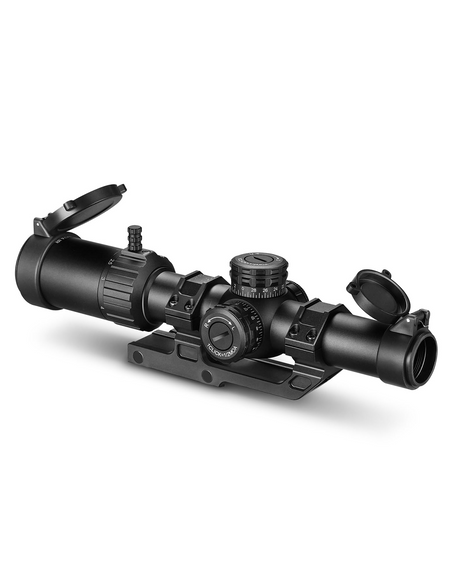
| Retícula 3-9x40 R4 | 3-9x | 40 mm | Fijo a 100 yardas | Tiro recreativo, primer visor para una 10/22, uso general con rifles de percusión anular | $30-$50 |
| JackalHowl F02 3-9x40 AO | 3-9x | 40 mm | AO de 10 yardas al infinito | Caza menor, tiro recreativo, tiro al blanco, cualquier 22LR entre 10 y 100 yardas | $50-$80 |
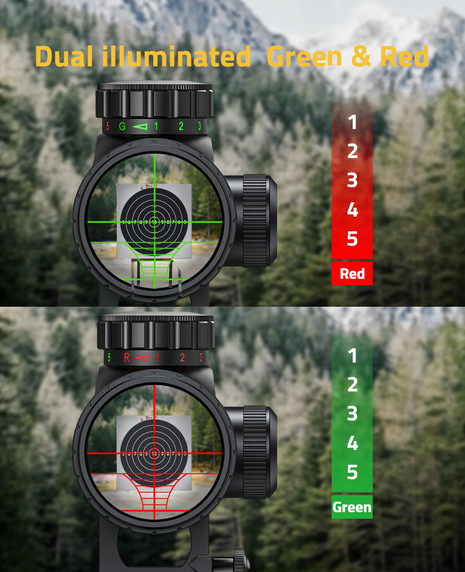
| 2.5-10x40 iluminado en rojo y verde | 2.5-10x | 40 mm | Fijo a 100 yardas | Caza con poca luz (conejos, ardillas al amanecer/anochecer) | $60-$100 |
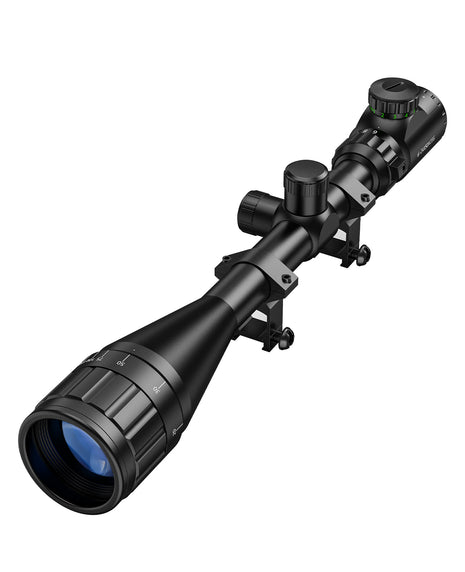
| 6-24x50 AOE iluminado | 6-24x | 50 mm | Enfoque lateral AO | NRL22, perros de la pradera, percusión anular a más de 200 yardas | $130-$200 |
04 ·¿Cuál es el mejor visor específicamente para una Ruger 10/22 Takedown?
La Ruger 10/22 Takedown tiene una particularidad en el riel del visor que sorprende a muchos compradores: el riel de fábrica es un adaptador de base de visor combinado para monturas con ranuras y monturas .22 tip-off, no un riel Picatinny auténtico. Según la ficha técnica de la Takedown de Ruger de 2026, el rifle incluye este adaptador de doble patrón, lo que significa que casi cualquier visor de percusión anular se puede montar con las anillas incluidas en la caja del visor.
Especificaciones del riel de la Ruger 10/22 Takedown (de fábrica)
- Patrón del riel
- Adaptador de base de visor combinado (compatible con ranuras y con montaje .22 tip-off)
- Longitud del riel de fábrica
- Aproximadamente 4 pulgadas (sección del receptor)
- Altura del riel de fábrica
- Perfil bajo (compatible con anillas estándar de 1 pulgada)
- Rieles de posventa compatibles
- Picatinny EGW de 0 MOA / 20 MOA, Picatinny Dlask Arms de 0,375" / 0,500", Picatinny Area 419 de 0 MOA / 30 MOA
- Especificación de torque para los tornillos de las anillas
- 18-25 libras-pulgada (varía según el fabricante de las anillas)
Para una 10/22 Takedown que se guarda en una mochila o debajo del asiento de una camioneta, el visor práctico es uno de 1-4x o 3-9x con una longitud total corta. El 3-9x40 R4 (30,99 cm de largo, 0,76 lb) cabe en la sección compacta del receptor de la Takedown. El 2.5-10x40 (32,51 cm de largo) también cabe. El 6-24x50 (36,83 cm de largo, 1,4 lb) es demasiado largo para la mayoría de los estuches de la Takedown y desequilibra el rifle al desmontarlo.
05 ·Cómo montar un visor para percusión anular en 3 pasos
El montaje para percusión anular es igual que el montaje para percusión central, pero la especificación de par es menor porque el retroceso es más reducido. Apretar demasiado la montura de un visor para percusión anular es un error común de los principiantes, y puede agrietar un tubo de 1 pulgada o deformar una anilla. El proceso de 3 pasos siguiente funciona con cualquier visor de tubo de 1 pulgada sobre un riel ranurado o Picatinny.
- Establece la separación de las anillas y aprieta las mitades inferiores. Coloca el visor sobre el riel, desliza las anillas hasta una posición aproximada (dejar visible una anchura de pulgar del tubo entre las anillas y la carcasa de las torretas es un buen punto de partida) y aprieta los tornillos inferiores de las anillas para fijarlas al riel. Usa la especificación de par de apriete indicada en la página del fabricante de las anillas: la mayoría de las anillas de 1 pulgada quedan entre 18-25 pulgadas-libra. Una pequeña cantidad de Loctite azul 242 en los tornillos de las anillas evita que se aflojen con el retroceso de la percusión anular (menor que el de la percusión central, pero aun así ocurre tras miles de disparos).
- Ajusta la distancia ocular y nivela la retícula. Monta el visor flojo en las anillas, apoya el rifle en el hombro en tu posición de disparo normal y desliza el visor hacia delante o hacia atrás hasta que todo el campo de visión sea visible sin anillos negros alrededor del ocular. Gira el tubo del visor hasta que la cruz vertical quede perpendicular al suelo por efecto de la gravedad: puedes usar un pequeño nivel de burbuja en la tapa de la torreta o mirar una plomada en la pared. La retícula debe estar nivelada respecto al rifle, no respecto a la cabeza del tirador.
- Aprieta las tapas de las anillas y verifica el ajuste. Aprieta las tapas superiores de las anillas siguiendo un patrón cruzado (delantera-trasera y luego de lado a lado) con el mismo valor de par que en el paso 1. No aprietes en exceso: un visor para percusión anular no necesita más de 30 pulgadas-libra, y la fuerza adicional solo puede dañar las roscas de los tornillos de las anillas o deformar el tubo. Dispara 3 cartuchos a un objetivo situado a 25 yardas, ajusta la deriva y la elevación para centrar el grupo, luego retira el rifle de los sacos de apoyo y vuelve a comprobarlo después de 5 minutos para confirmar que mantiene el ajuste. Si no lo mantiene, los tornillos de las anillas no están apretados uniformemente o el visor no está bien asentado en las anillas.