
Featured collection
-
-
$159.99 $136.79
-
-
$57.59

This blog explains how to match a riflescope to your specific caliber. The key point: the “best” scope is the one that fits your rifle and hunting style, not necessarily the most expensive one. The decision comes down to four factors. Recoil determines durability — .22LR works with almost any scope, but .308 and above require proven shock resistance, and magnum calibers need rugged one-piece construction. Ballistics guide reticle choice — long-range calibers like .308 and 6.5 Creedmoor benefit from Christmas-tree reticles for holdover and windage, while magnum rifles under 300 yards are better served by clean crosshairs. Use case dictates magnification — .22LR works with 3-9×, AR-15s suit LPVOs, medium bolt-actions need 3-15× or 5-25×, and magnums require 5-25× and above. Mounting compatibility is critical too — tube diameter, ring height, and rail type must all match.
Buying a riflescope online usually goes like this:
You find a scope that looks great on paper — right magnification, reticle you like, price fits the budget. Order it. Mount it. Head to the range. A few shots in, you start noticing problems:
· That red dot on your shotgun started shifting after fifty rounds.
· That lightweight compact scope on your .308 doesn't have enough elevation adjustment to reach 400 yards.
· That tactical scope with perfect balance specs made your .22LR feel front-heavy and awkward.
It's not that the scope is bad. It's that you picked the wrong one for your rifle.
Different calibers have completely different requirements for optics. This article helps you sort it out: figure out what caliber you're shooting and what you're using it for, then match it to the right scope — no more guesswork.

This is the most overlooked factor, and the most important.
A scope's tube construction, ring-clamp surface design, and internal component retention — these determine how much shock it can handle. Recoil varies wildly across calibers:
|
Caliber Type |
Typical Recoil (Free Recoil Energy) |
Scope Requirement |
|
.22LR |
Very Low (≈1-2 ft·lb) |
Almost any scope will hold up |
|
.223 / 5.56 |
Low to Moderate (≈5-8 ft·lb) |
Most civilian-grade scopes are fine |
|
.308 / 7.62 NATO |
Moderate to High (≈15-18 ft·lb) |
Requires solid shock-resistant construction |
|
.30-06 |
High (≈18-22 ft·lb) |
One-piece tube construction + reliable ring lock-up |
|
Magnum (e.g., .300 Win Mag) |
Very High (25+ ft·lb) |
Must have rigorous shock-test certification |
The rule: If you're shooting .308 and above, check one spec before buying —shock-test rating. Cheap scopes can start losing zero, developing loose internal components, or showing reticle shift within a couple dozen rounds on heavy-recoiling rifles. Not because they're poorly made, but because they weren't designed for that recoil level in the first place.
How to read this in product specs: Look for explicit shock-test data. If you're shooting a heavy caliber, prioritize scopes with published shock-test data. If you're shooting .22LR, don't pay extra for shock protection you'll never use.
Different calibers have completely different bullet trajectories. A .22LR might drop over 30 inches at 200 yards, while a .308 might drop only about 8 inches at the same distance.
Here's what that means for your scope choice:
For low-velocity, high-drop calibers like .22LR,you need a reticle with ample holdover reference marks — or a simpler reticle paired with generous elevation adjustment range. Otherwise, once you're past 50 yards, your point of impact might drop below the field of view, leaving you with no aiming reference at all.
For mid-to-long-range calibers like .308 and 6.5 Creedmoor,a Christmas-tree style reticle is genuinely useful — windage and elevation holdover references are right there in the glass. You don't have to "guess how much to hold over" — the reticle gives you actual MOA values to work with.
For bolt-action magnum hunting rifles (.30-06, .300 Win Mag), you might not need a complex reticle at all. A clean crosshair with a few mil-dot references, paired with reliable zero retention and solid adjustments, often serves better. Magnum hunting rifles typically engage targets inside 300 yards, where bullet drop is still manageable — a cluttered reticle just obscures your target.
The rule:More reticle complexity isn't always better. Unless you're regularly shooting past 200 yards, a simple crosshair with mil-dot references will serve you better than a full Christmas tree — cleaner sight picture, faster target acquisition.
Different calibers typically go with different use cases:
.22LR / Rimfire:
· Typical Distance: 25-100 yards
· Recommended Magnification: 2-7×, 3-9×, 4-12×
· Low end gives you a wide field of view for quick target pickup at short range; high end gives you enough magnification to see your hits at 100 yards
· No need for large objective lenses (40mm and under is fine), since daytime range use is the primary scenario
AR-15 Platform (.223 / 5.56):
· Typical Distance: 50-300 yards
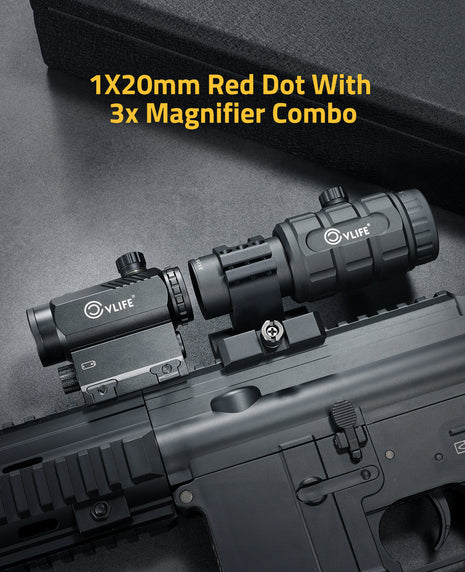
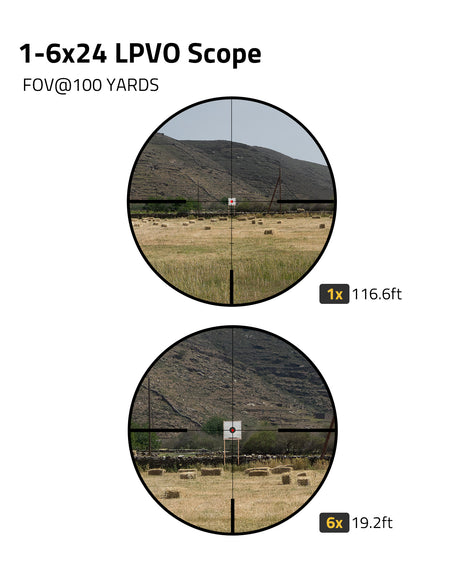
· Recommended Magnification: 1-6×, 1-8× LPVO, or red dot + magnifier combo
· If you're mainly doing tactical training and close-quarters work, prioritize an LPVO with true 1× performance
· If you're hunting deer or coyotes with it, consider a 3-12× or 4-16× conventional variable scope
Medium-Caliber Bolt-Action (.308, .30-06, 6.5 Creedmoor):
· Typical Distance: 100-600 yards
· Recommended Magnification: 3-15×, 4-16×, 5-25×
· Open terrain = more magnification on the high end; timber hunting = lower magnification on the low end
· 56mm objective lenses provide noticeable low-light advantage for dawn and dusk hunting
Magnum Calibers (.300 Win Mag and above):
· Typical Distance: 200-800+ yards
· Recommended Magnification: 5-25×, 6-24×
· These rifles are typically used for long-range hunting in open terrain — high magnification is a necessity
· Tube construction and shock resistance come first; magnification comes second
The rule: Bigger magnification range isn't always better. Higher magnification means narrower field of view, heavier scope weight, and potentially compromised performance at the low end. Figure out where you'll be shooting and at what distance, then pick your magnification range accordingly.
This is the trap that catches everyone: you buy the scope, and it won't fit.
Tube Diameter Match: Scope tubes come in 1-inch, 30mm, or 34mm. Your rings must match that diameter exactly. Check your scope's tube size before ordering rings.
Ring Height: The larger your objective lens, the higher your rings need to be. A 56mm objective with low rings will hit the barrel or handguard.
Rail Type: Most modern rifles have Picatinny or Weaver rails. Confirm which one your rifle has before buying rings — they're not fully interchangeable.
The rule: When buying a scope, confirm whether the included rings match your rifle's rail. If you're unsure, look up your rifle's specs before placing the order.
|
Your Caliber |
Primary Use |
Recommended Magnification |
Objective Lens |
Reticle Suggestion |
|
.22LR |
Range / Small Game |
3-9×, 4-12× |
40mm or under |
Simple crosshair or BDC |
|
.223 / 5.56 |
Tactical / Coyote |
1-6×, 1-8×, 3-12× |
40-50mm |
Christmas tree or BDC |
|
.308 / 7.62 |
Deer / Hog / Range |
3-15×, 4-16×, 5-25× |
44-56mm |
Christmas tree MOA |
|
6.5 Creedmoor |
Long-Range / Hunting |
4-16×, 5-25× |
50-56mm |
Christmas tree MOA |
|
.30-06 |
Big Game |
3-15×, 4-16× |
44-50mm |
Simple crosshair + mildot |
|
.300 Win Mag |
Long-Range Big Game |
5-25×, 6-24× |
50-56mm |
Simple mildot or BDC |
 Some Practical Advice
If you have one rifle and one budget, spend your money on "fit" rather than "features."A mid-range scope that perfectly matches your caliber and use case will serve you better in the field and on the range than a high-end scope with specs you'll never use.
Another detail that's easy to overlook: weight. A few extra ounces might not seem like much, but putting a near-2-pound scope on a lightweight hunting rifle completely changes the balance — you'll find yourself wobbling on target acquisition. Always consider your rifle platform: a lightweight carbine pairs well with a lightweight scope; a heavy precision rifle naturally calls for a larger, more robust optic.
A riflescope isn't about higher magnification or bigger objective. It's a tool with one job: to give you a clear, reliable aiming point when it's time to take the shot.That's it. How much you spend and what brand you buy should both revolve around that single objective.
$159.99 $136.79
$57.59


