When does a hunting scope stop working at 600 yards?
The relationship between magnification and actual distance:
- 1-6x — 0-300 yd (3-gun, hunting, close shooting)
- 3-9x — 100-500 yd (classic hunting scope; marginal at 600)
- 4-12x — 200-600 yd (entry-level long-range)
- 6-24x — 400-1,000+ yd (long-range standard)
- 8-32x — 600-1,500+ yd (F-class and ELR)
The 4-12x is the smallest range that can reach 600. The 6-24x is the most common dedicated choice. None of the lower ranges have enough top-end magnification to spot impacts or read mirage reliably.
5 specs that matter at 600 yards
| Spec | What to look for | Why at 600 yd |
|---|---|---|
| Magnification | 5-25x or 6-24x | 18-25x to spot impacts and read mirage; below 12x is marginal. |
| Focal plane | First Focal Plane (FFP) | Subtensions scale with magnification; Mil/MOA holds work at any power. |
| Turret | Target turret with zero stop | 10+ MOA of dial at 600 yd; zero stop returns to 100-yd zero without counting clicks. |
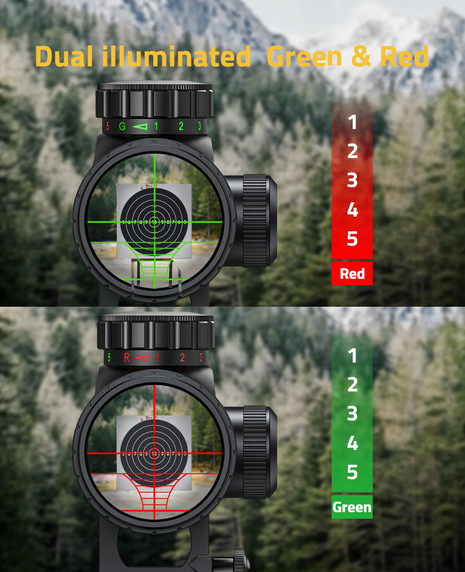
| Reticle | Mil, MOA, or BDC for your load | Holds replace dialing; ranging reticles confirm distance without a rangefinder. |
| Parallax | Side focus, 50 yd to infinity | Wrong setting shifts impact 1-3 in at 600 yd. Non-negotiable above 200 yd. |
4 optic classes for 4 types of shooters
Pick the class that matches how you actually shoot, not the one with the most impressive numbers.
| Class | Magnification | Best for |
|---|---|---|
| Mid-power | 4-16x | Mostly 200-400 yd; curious about 600 |
| Long-range | 5-25x or 6-24x | 600 yd primary, 1,000 yd capable (the standard) |
| Extended long-range | 6-36x | F-class and ELR competitor |
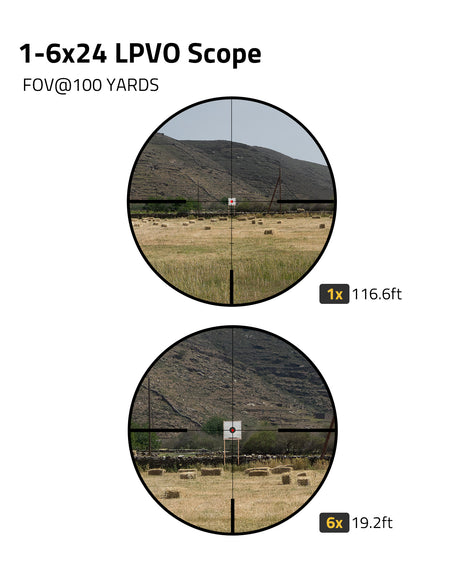
| LPVO | 1-6x | 3-gun and tactical; not for dedicated 600 precision |
If 600 yards is your primary distance, the 5-25x or 6-24x is the right call. If you also shoot 1,000+ yards, the 6-36x. If mostly 200-400 yards, the 4-16x. The 1-6x is for a different job.
FFP, BDC, Mil, or MOA — which reticle fits 600 yards?
FFP (first focal plane) reticle scales with magnification — a 1 Mil hashmark is 1 Mil at 1x or 25x. Holds and ranging work at any power. SFP (second focal plane) is only true at one published magnification; you must dial to that power before using holdover marks. For 600 yd, FFP wins.
BDC (Bullet Drop Compensator) is pre-calibrated for one load at one set of distances. Mil and MOA reticles with Christmas-tree subtensions are flexible across loads. BDC is faster if you only shoot one load. Mil/MOA is faster if you change loads.
The numbers (JBM Ballistics, 100-yd zero):
200 yd: 1.2 MOA · 300 yd: 3.1 MOA · 400 yd: 5.2 MOA
500 yd: 7.6 MOA · 600 yd: 10.2 MOA (~2.97 Mil)
6.5 CM 140 gr @ 2,710 fps, 100-yd zero:
600 yd: 9.0 MOA (~2.62 Mil)
10 mph crosswind at 600 yd (JBM):
.308 Win 175 gr: 10-12 in · 6.5 CM 140 gr: 8-10 in
5-step mount, level, zero, verify
Bench time is about 60 minutes. The 600-yard verification adds another 30-45 minutes plus travel.
-
Rail, rings, tube diameter.
Confirm a 20 MOA or longer Picatinny rail. Match ring diameter to scope tube (30mm or 34/35mm). Torque rings to 15-25 in-lb per the manufacturer spec.
-
Level the base and rings.
Use a scope level on the rail and on the ring tops. A 1-degree cant will pull windage at 600 yd. Most-overlooked step.
-
Set eye relief at 3.5-4 in.
Shoulder the rifle in your natural prone or bench position. Cross-tighten ring screws in two passes (50% then 100%).
-
Bore-sight at 25 yd, zero at 100 yd.
Laser or magnetic bore-sighter first. Confirm at 100 yd with 3 rounds, walk the reticle to the group center.
-
Verify at 600 yd and write down actual holds.
Fire a cold-bore 5-shot group at 600 yd. Compare to your ballistics prediction (10.2 MOA for .308 175gr; 9.0 MOA for 6.5 CM 140gr). Adjust the elevation turret to match. Write down the actual hold for each distance on a card taped to the stock.
4 questions buyers ask
-
What magnification for 600 yards?
Minimum 10-12x is useful; 18-25x is the practical sweet spot. A 4-12x can reach 600 but offers little headroom for spotting impacts. The 5-25x or 6-24x is the standard long-range choice.
-
FFP or SFP for 600 yards?
FFP. Subtensions scale with magnification so holdover math and ranging work at any power. SFP is only true at one published magnification.
-
Do I need a zero stop?
Yes. At 600 yd you will be dialing 10+ MOA. A zero stop returns the dial to your 100-yd zero without counting clicks.
-
30mm or 34mm tube?
30mm is adequate for .308-class work at 600 yd. 34-35mm is preferred for 1,000+ yd headroom.