
Featured collection
-
-
$159.99 $141.99
-
-
$70.19

Ranging is the most overlooked skill in long-range hunting. Inside 50 yards, it doesn't matter. Past 300, a 20-yard error can turn a clean kill into a miss. This article covers three ways to range: eyeballing it with practice, using a laser rangefinder for precision, and ranging through your scope's reticle without extra gear. Each has its place. The laser is the most dependable past 300 yards. The reticle method saves weight and works in any weather. Eyeballing is the fallback when all else fails. The key takeaway: learn the fundamentals first, then add the tools. Practice until ranging becomes automatic — because in the field, you won't have time to think about it.
The biggest difference between close-range shooting and long-range shooting isn't bullet drop compensation or wind correction — it's that you don't know how far the target is.
Inside 50 yards, bullet drop is negligible. Point and shoot. At 200 yards, a 1-yard ranging error might shift your impact by half an inch — no big deal for hunting. At 400 yards, that same 1-yard error can push your impact several inches off. At 600 yards, if you're off by 20 yards, your bullet might miss the vital zone entirely. On the range, you can take another shot. In the field, the animal is gone.
This article covers one thing: how to range accurately and quickly in the field, and when to trust your eyes versus when to trust your gear.
Before you buy any ranging device, learn one basic skill: estimating distance with your eyes.
Here's how: pick a familiar reference — say, an adult deer's body length, roughly 3-4 feet. Estimate how many mils or MOA it occupies in your scope, then convert that to distance. If you're using a mil-dot reticle, each dot spacing is 1 mil. At 100 yards, 1 mil equals about 3.6 inches. If you know the target's approximate size, you can work backward to distance.
Example: a mature whitetail deer from chest to rump is about 3 feet (36 inches) long. If it covers 2 mils in your scope, the distance is roughly 36 ÷ (2 × 3.6) × 100 ≈ 500 yards. That math sounds clunky, but with practice, you can do it in a few seconds.
An even simpler approach: use the known spacing on your reticle to "bracket" the target. If two adjacent mil-dots cover 3.6 inches at 100 yards and 7.2 inches at 200 yards — and you know a deer's body length is about 3 feet — counting how many dots it fills gives you a fast distance estimate. You don't need precision to the yard. "Around 300" is enough to make a good holdover call.
As good as your eyes might be, they have limits. Past 300 yards, human distance perception gets unreliable. That's where a laser rangefinder comes in.
The concept is simple: fire a laser at the target, measure the time it takes to bounce back, and calculate the distance. Press a button, get a yard-accurate number in under a second. Simple in theory — but in practice, a few details matter.
First, rangefinders need a steady hold. At long range, even slight hand shake can put the laser on a branch next to your target instead of the target itself, giving you a reading that's way off. Inside 100 yards, you can usually get away with handheld. Past 300 yards, brace it against something — a tree, your pack — or use a tripod.
Second, the transition from rangefinder to scope takes practice. You get a reading of 320 yards. Now you need to find the corresponding holdover point in your scope — fast. If that transition isn't smooth, being off by a few yards might not matter much, but being off by tens of yards at extended distances changes the impact point entirely. Experienced hunters practice this transition on the range until it's automatic.
Third, rangefinders aren't magic. In rain, fog, or when the target is behind glass, the laser return signal weakens. You might get no reading at all — or worse, an inaccurate one. Also, if you range the ground next to the target instead of the target itself, the distance you get might not match your actual shot.
If you don't want to carry another device in the field, there's another way: use your scope's reticle to range.
Same principle as eyeballing it, but more precise. Your reticle has mil-dots or MOA hash marks. Use them to "measure" the target's size, then convert to distance. The mil-ranging formula is: Distance (yards) = Target Size (inches) × 27.8 ÷ Mils. MOA is slightly different: Distance (yards) = Target Size (inches) × 95.5 ÷ MOA.
The upside: no extra gear. You see the target, you range it. The downside: you need to know the target's approximate size, and you need practice to do it quickly and accurately. For experienced hunters, this is one of the most dependable methods — no batteries required, unaffected by weather.

If you regularly shoot past 300 yards, a laser rangefinder is the most dependable choice. Its precision is physical — not subject to your judgment or fatigue.
If you want to travel light or work within a tighter budget, learning reticle-based ranging is the most practical skill you can develop. For most mid-range hunting scenarios, it gives you enough accuracy to make a good shot. But you have to practice it first.
Eyeballing distance is an emergency skill — and a fundamental one. Even with a rangefinder, keep the habit of estimating distance with your eyes. When batteries die, devices fail, or targets are partially obscured, that skill might be your only option.
Whether you're using your eyes or your reticle, ranging takes practice. One effective drill: in familiar terrain, walk a known distance, stop, and guess how far you just walked. Then check. Do it over and over — hundreds of times — and you'll develop a feel for distance that no gadget can replace.
On the range, set targets at different distances and practice ranging them. Estimate first, then verify. Compare the two numbers and see if you consistently overestimate or underestimate. That process is more valuable than any theory.
Ranging isn't everything in hunting. But for long-range shots, it's essential. Gear can reduce your error, but the final call is still yours — made in the moment, under pressure. Build the foundation first, then add the tools. Don't reverse the order.
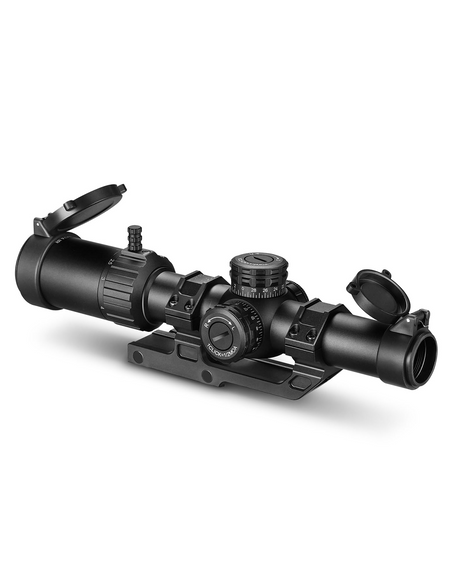
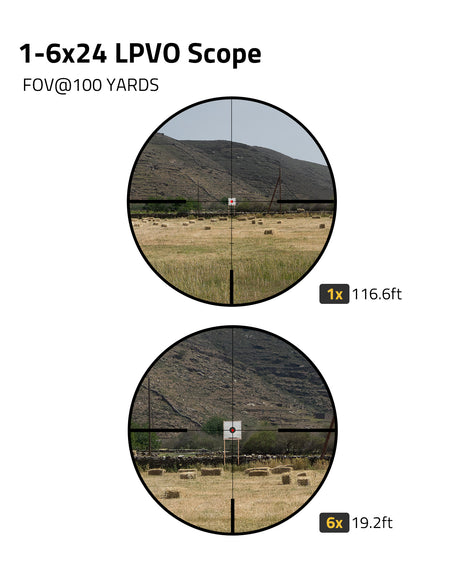
If you're looking for a scope with a mil-dot reticle, the CVLIFE BearPower 5-25x56 FFP is worth a look. The Christmas-tree MOA reticle has built-in holdover marks, and because it's first focal plane, the mil-dot spacing stays accurate at any magnification. It's a solid choice for hunters who want ranging capability without carrying extra gear.
$159.99 $141.99
$70.19


