
Featured collection
-
-
$159.99 $136.79
-
-
$57.59

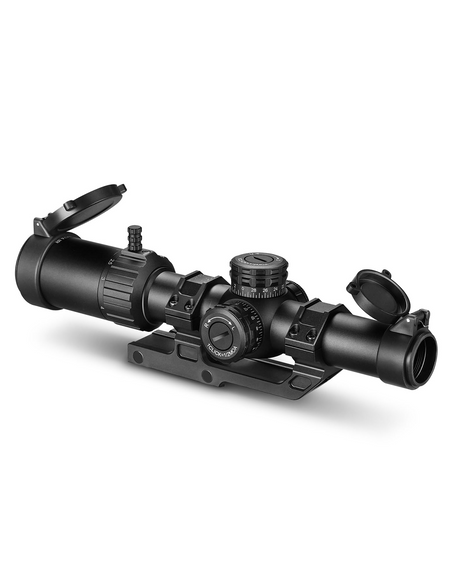
MPVO (Medium-Power Variable Optic) fills the gap between LPVOs and full-size scopes. The CVLIFE EagleFeather 2-10x32 MPVO AO offers 2-10× magnification, adjustable objective for parallax control, locking turrets, a BDC illuminated reticle, and an included cantilever mount — all at $109.99. It's built for AR-15 and bolt-action shooters who need more reach than a 1-6× LPVO but don't want the bulk of a full-size scope. 2× on the low end handles close-range work well enough, while 10× on the high end delivers clarity and detail for 200-300 yard shots. It's lightweight, compact, and tested to 1000G with waterproof/fogproof sealing. Bottom line: if you shoot mid-range distances and want precision without the weight or price tag of high-end optics, this MPVO is a solid choice.
If you've been shopping for optics for your AR-15 or bolt-action rifle lately, you might have noticed a trend: LPVOs are everywhere, but more and more shooters are talking about MPVOs.
MPVO stands for Medium-Power Variable Optic. Think of it as the LPVO's bigger sibling — more magnification, more reach, without adding much bulk or weight.
The CVLIFE EagleFeather 2-10x32 MPVO AO is a textbook example: 2-10× magnification, 32mm objective, adjustable objective (AO), locking turrets, and a cantilever mount included. This article covers one thing: who needs it, what problem it solves, and why it might fit you better than an LPVO.
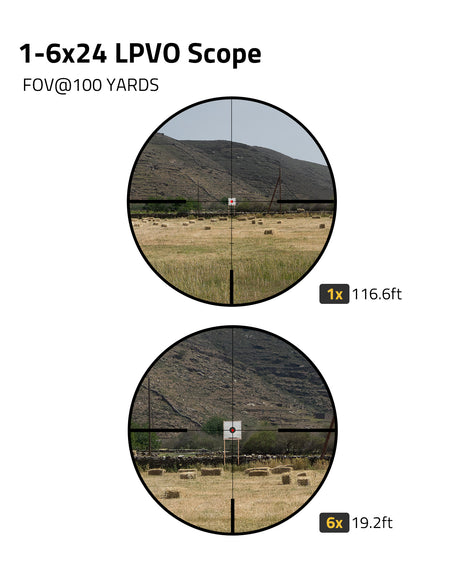
LPVOs (Low Power Variable Optics) typically run 1-6×, 1-8×, or 1-10×. Their low end is 1×, which lets you use them like a red dot. MPVOs start at 2× or higher on the low end, and push to 10×, 12×, or beyond on the high end.
That difference defines their roles:
LPVO: Built to balance close-quarters and mid-range. Great for AR-15s, home defense, and tactical training. At 1×, you get both-eyes-open speed that's nearly as fast as a red dot. But past 6×, the image quality and light transmission start to suffer due to the smaller objective size.
MPVO: Built for mid-to-long-range precision. Think DMRs (Designated Marksman Rifles), bolt-action hunting rifles, and any scenario where you need to identify and engage targets at distance. At 2×, it's still fast enough for both-eyes-open shooting in a pinch. At 10×, the clarity and detail are something an LPVO can't match.
Simply put: LPVOs are designed to be fast up close and adequate at distance. MPVOs are designed to be precise at distance and adequate up close.
The 2-10× range covers everything from 50 yards out to 300 yards and beyond. At 2×, the field of view is wide open — perfect for scanning treelines and picking up moving targets. At 10×, you've got enough magnification to read target details and make precise holdover calls.
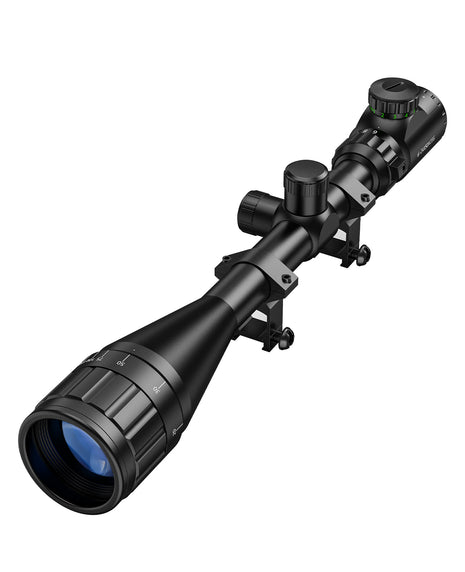
Adjustable Objective (AO) is a practical feature on this scope. It lets you dial out parallax by rotating the objective ring. Set it to the distance you're shooting, and the target snaps into sharp focus — eliminating the aiming error that comes from parallax misalignment. AO is uncommon at this price point, but it's exactly what you need for consistent accuracy at varying distances.
The elevation and windage turrets are exposed, with 1/2 MOA per click — tactile, audible, and easy to use without looking at them. The locking mechanism is rare in this price bracket: dial your correction, push the turret down to lock it, and it won't move when bumped in your pack. On a hunting rifle that gets thrown in the truck and carried through brush, that's a feature you'll appreciate every time you take a shot.
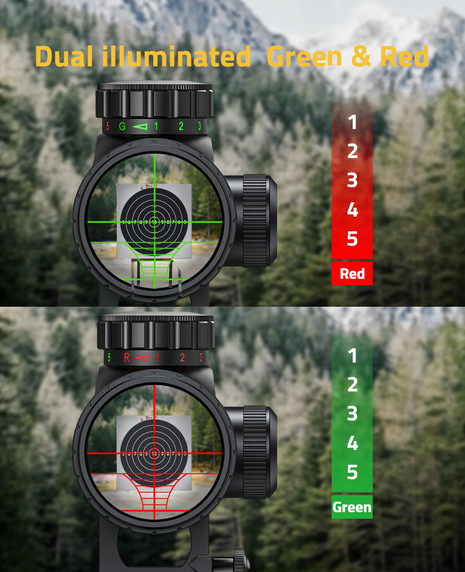
The reticle is a BDC (Bullet Drop Compensating) dot-style design with 5-level red and green illumination. BDC reticles simplify holdover — after zeroing, each dot corresponds to a specific distance. No math, no mil-dot counting. Just range it, pick the dot, and shoot. For quick shots in the field, it's cleaner and more intuitive than a busy Christmas-tree reticle.
The included 30mm cantilever mount is designed specifically for AR-15 style rifles with Picatinny rails. It extends the scope forward over the handguard, letting you achieve proper eye relief while keeping the rings mounted on the receiver rail. One less thing to buy, one less thing to worry about.
The tube is aircraft-grade aluminum, measuring 9.25" long, 2.3" wide, and 2.55" high. It's passed over 500 rounds of 1000G impact testing, nitrogen-purged, and O-ring sealed for waterproof and fogproof performance.
AR-15 shooters who want something more reliable than a red dot + magnifier combo, and who regularly shoot past 200 yards.
Deer and hog hunters working field edges and transition zones where shots can come at 50 yards or 250 yards on the same sit.
Range shooters who want to stretch their legs into mid-range precision without dropping serious money on high-end glass.
Anyone setting up a rifle for a smaller-statured shooter — the forgiving eye relief and wide eyebox make it easy to get a full sight picture without craning your neck.
The CVLIFE EagleFeather 2-10×32 MPVO AO isn't for everyone. If you're strictly inside 100 yards and want maximum speed, a red dot or LPVO might serve you better. But if you need a scope that can reliably reach 200 or 300 yards, stays compact and lightweight, and won't make you second-guess the price — this 2-10×32 deserves a long look.
MPVO answers a question that LPVOs can't quite address: "What if I want more reach than a 1-6×, but I don't want to haul a heavy, bulky standard scope into the field?"
The answer is the EagleFeather 2-10×32. Lightweight, compact, 2-10× magnification, AO parallax control, locking turrets, and a cantilever mount included — it covers what you need, and it covers what you didn't think to ask for.
$159.99 $136.79
$57.59


