Long range precision shooting is the engineering task of holding sub-MOA groups beyond 600 yards. Six parameters drive that outcome: barrel twist rate matched to bullet weight, action stiffness, optic first-focal-plane configuration, trigger break weight, ammunition lot consistency, and prone position practice. Every other build decision descends from those six.
Key takeaways
- Sub-MOA performance is a property of the whole system, not of any single component. A $400 optic on a $1,500 rifle out-shoots the same optic on a $700 rifle.
- First-focal-plane (FFP) scopes are required at distances beyond 350 yards because reticle subtensions stay constant at any magnification. Second-focal-plane (SFP) scopes introduce hold errors past that point.
- Factory match ammunition closes the lot-consistency gap for new shooters; handloading closes the last 10–15% but requires a chronograph and a scale.
- A 6.5 Creedmoor rifle in a 13-lb chassis with a quality optic and a 2-lb trigger reaches 800-yard steel with practice. .308 Winchester does the same job at half the trigger cost.
- Position practice matters more than the rifle. A $3,000 setup fired from a sloppy prone position loses to a $1,000 setup fired with bone support and a rear bag.
Quick answer
If you're starting out: pick a 6.5 Creedmoor or .308 Winchester bolt-action in a chassis, mount a quality optic with 5–25x first-focal-plane magnification on Mil-Spec 1913 bases, set the trigger at 2 lb, source match-grade ammunition, and spend the next 200 rounds in prone position at 100 yards. That sequence covers roughly seventy percent of the lift from home-range shooter to first-time 800-yard steel hit.
Table of contents
Key terms
- Sub-MOA
- Sub-MOA rifles hold five-shot groups under 1 MOA (1.047 inches) at 100 yards.
- MOA
- Minute of Angle, 1.047 inches at 100 yards. Scope adjustments in 0.25 MOA per click move point of impact 0.262 inches at 100 yards per click.
- First focal plane (FFP)
- Reticle sits at the front of the erector assembly; subtensions stay constant at any magnification.
- Second focal plane (SFP)
- Reticle sits behind the erector assembly; subtensions grow and shrink with magnification.
- Twist rate
- Barrel rifling advance per turn, expressed in inches (1:8 means one full turn in 8 inches).
- Bullet BC (Ballistic Coefficient)
- Measure of how a bullet resists drag in flight; higher BC flattens trajectory and holds energy at range.
- Lot consistency
- Velocity spread and accuracy spread across ammunition boxes from one factory lot.
- Prone position
- Standard precision-shooting body position: flat on the ground, rear bag under the buttstock, bone support from elbows to heels.
The six parameters, ranked by leverage
Not all parameters contribute equally. New shooters who fix the wrong thing first end up spending money where they don't need it.
1. Position practice
The single highest-leverage factor. A shooter in proper prone with a rear bag beats a sloppy-prone shooter on a $3,000 rifle. Time on the mat costs nothing.
2. Ammunition lot
A rifle accurate to 0.6 MOA with one lot opens to 1.4 MOA with another lot. Sample three factory match loads before committing to one.
3. Optic quality
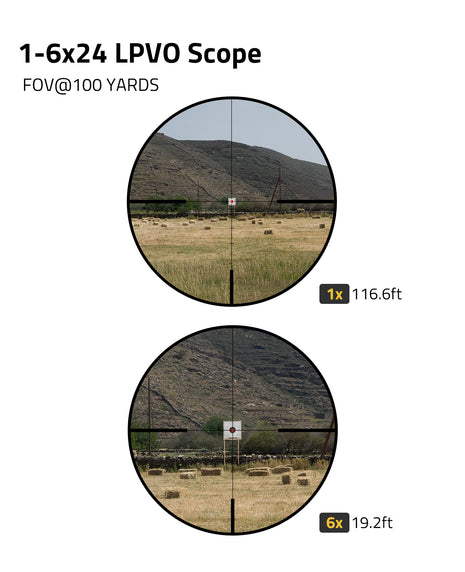
A first-focal-plane precision optic in the 5–25x range covers everything from 200-yard practice to 1,000-yard steel. Skip LPVO scopes rated for under 8x past 350 yards.
4. Trigger break
A 2-lb trigger with clean break drives tighter groups than a 5-lb factory trigger. Adjustable aftermarket triggers are not optional on a precision build.
5. Barrel match
Twist rate matched to bullet weight stablises the bullet in flight. Mismatched barrels print oddly shaped groups.
6. Action stiffness
Stiffer actions hold zero under heat and pressure. Light sporter actions are fine for hunters; match shooters want bedding-bolt actions.
Optic configuration: FFP vs SFP for precision
At distances under 350 yards, both focal-plane configurations work. Past 350 yards, FFP scopes are required for any holdover-based shooting because the reticle grows and shrinks inversely with magnification only when in second-focal-plane locations. First-focal-plane scopes keep the same angular subtension in mils or MOA at any magnification, so the reticle math the shooter uses to compute hold stays consistent across the magnification range.
| Optic configuration | Best at | Why |
|---|---|---|
| First focal plane, 5–25x | 100–1,000 yd | Reticle math holds at any magnification; mil or MOA holdover stays valid through the zoom range. |
| Second focal plane, 4–16x | 0–350 yd | Cheaper than FFP; magnification-dependent subtension is workable if the shooter holds at a single magnification. |
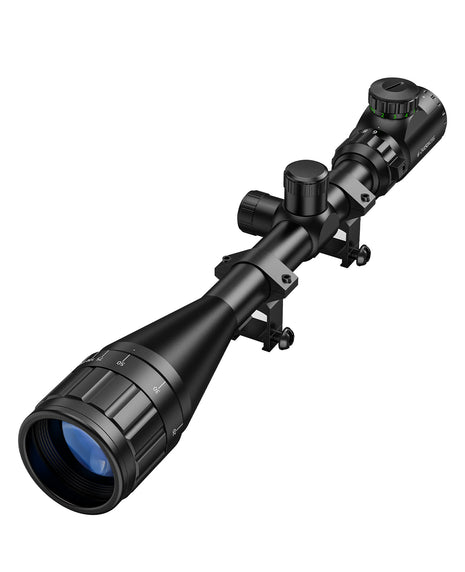
| LPVO scope, 1–6x or 1–8x | 0–250 yd | Real for close-range dynamic shooting; sub-MOA precision groups out of FFP/FFP-style optic. |
| Tactical rifle scope, 3–18x FFP | 100–700 yd | Mid-range precision; covers most club-level PRS stages without reticle math issues. |
Long range precision shooters often pair the precision optic with a tactical rifle scope as a backup or for stages where magnification is constrained. The general rule: the further the engagement window, the higher the minimum magnification the optic must hold at full zoom.
Barrel twist rate and bullet weight pairing
A barrel with a 1:8 twist stabilises a 140-grain 6.5 mm bullet but cannot stabilise a 90-grain bullet at lower temperatures. The rule is simple: heavier bullets need faster twist. Factory barrels list the recommended bullet-weight range on the barrel-makers page; custom barrelmakers pick the rate against the shooter's preferred load.
| Twist rate | Stabilises | Common in |
|---|---|---|
| 1:7 | 55–80 gr 5.56 mm | AR-pattern precision builds |
| 1:8 | 75–140 gr 6.5 mm | 6.5 Creedmoor hunting and PRS rifles |
| 1:9 | 110–150 gr .308 | .308 Winchester hunting rifles |
| 1:10 | 150–210 gr .30 cal | Long range precision heavy bullet work |
Action stiffness and chassis geometry
Stiffness is the difference between an action that returns to battery after 200 rounds and one that returns after 800. Bedding-bolt actions with integral recoil lugs and a clean-bottom receiver face hold zero longer under heat. Chassis geometry matters because: (a) a forend with an industry-standard Picatinny rail lets the shooter adjust bipod location; (b) an adjustable cheek riser lets the shooter set head position consistently behind the optic; (c) a folding or fixed stock lets the shooter adapt the length-of-pull to body gear.
Position practice: what actually moves groups
Practice is where the system gets proved. Three checks in the first 200 rounds at 100 yards establish a baseline:
- Bone support — elbows to the ground, heels together. Loose elbows are the most common cause of vertical stringing.
- Rear bag fill — the bag should hold the stock without compressing to its bottom. Under-filled bags cause vertical movement as the bullet leaves.
- Natural point of aim — the rifle should sit on the target with the shooter's shoulder relaxed. Tightened shoulder muscles introduce aiming error.
Five setup mistakes that cost sub-MOA
- Buying an LPVO scope for 800-yard work. LPVO scopes rated 1–6x become difficult past 350 yards. A precision FFP scope is the answer at that distance.
- Skipping ammunition sampling. Different factory lots print differently in the same barrel. Sample three before committing.
- Mounting a bipod at the gas block. Couples barrel vibration into the optic line and opens groups. Mount at the forend, away from the gas system.
- Putting the trigger at factory weight. 5–7 lb factory triggers kill sub-MOA. Set the trigger at 2 lb before the first group.
- Cleaning every 50 rounds. Barrels need fouling for the first 60–80 rounds to settle. Clean after that baseline, then schedule cleanings based on group drift.
Frequently asked questions
What caliber is best for a first long range precision rifle?
Most shooters start with 6.5 Creedmoor or .308 Winchester. Both have match-grade factory ammunition, predictable recoil, and bullet BC values that hold up to about 800 yards without wind-reading difficulty.
Is an LPVO scope enough at 600 yards?
LPVO scopes rated 1–6x or 1–8x become difficult past about 350 yards because reticle subtensions compress at high magnification. A first-focal-plane scope with 5–25x range handles engagement windows up to 1,000 yards reliably.
How often should you clean a precision rifle barrel?
Match shooters clean every 200–400 rounds or when groups open by more than 0.3 MOA from baseline. Hunting rifles can go 500–800 rounds because fouling is less critical for environment-of-use work.
What is MOA on a long range scope?
MOA (Minute of Angle) is 1.047 inches at 100 yards. A scope with 0.25 MOA per click adjustment moves the point of impact 0.262 inches at 100 yards per click. Sub-MOA rifles hold under 1 MOA five-shot groups at 100 yards.
Do you need a chassis for a precision rifle?
A chassis with a folding stock, compatible with M-LOK forend, and adjustable cheek riser is optional but useful. Stock rifles weigh 9–11 lb and shoot to print; chassis rifles weigh 11–13 lb and allow accessory mounting without bedding problems.
- NRA Long Range Shooting curriculum overview: nra.org
- Precision Rifle Series (PRS) rulebook, 2026 edition: precisionrifle.org