Parallax Explained: What It Is & How To Adjust Parallax Correctly
7 min reading time
Parallax Is Your Silent Accuracy Killer
Most shooting inaccuracy is not caused by bad zero, shaky hands, or wind. It comes from uncorrected parallax — an invisible optical error that shifts your point of aim even when your rifle is perfectly stationary.
New shooters often believe that if their reticle is clear and their target is sharp, their scope is perfectly aligned. This is a dangerous misunderstanding. Image sharpness does not equal parallax-free alignment.
In this in-depth guide, we dive into the true optical physics of parallax, explain why it creates inconsistent shots, break down the difference between AO and side-focus adjustment systems, and share professional-level techniques to eliminate parallax completely for hunting, range training, and long-range precision shooting.
What Is Parallax? The Real Optical Definition (Advanced Breakdown)
A riflescope works by aligning two critical focal planes:
1. Target focal plane — The focused image of your distant object
2. Reticle focal plane — The etched glass aiming reference inside your scope
Parallax occurs when these two focal planes do not perfectly overlap.
When misalignment exists, the reticle floats independently of the target image. Every minor vertical or horizontal shift of your eye behind the scope creates a completely new aiming point. This means your point of impact changes without you moving the rifle at all.
Why Parallax Error Gets Worse At Close Range (Key Physics)
Almost all factory-fixed parallax scopes are calibrated at 100 yards. At this distance, the light rays entering the scope are nearly parallel, minimizing focal plane mismatch.
At distances below 100 yards, light rays strike the objective lens at steeper, divergent angles. This pushes the target focal plane forward, creating severe separation between target image and reticle. This is why close-range shooting produces the largest parallax errors — often enough to miss small targets completely.
How Parallax Destroys Your Shot Consistency
Parallax error is subtle but devastating. Here is exactly how it affects your shooting:
Perfect eye position: Your shot lands true to zero
Slightly high eye position: Reticle drifts downward on target → shot hits low
In field conditions, your head and cheek weld will never be 100% identical shot after shot. Uncorrected parallax turns minor natural body variation into major group dispersion.
Two Parallax Adjustment Systems: AO vs Side-Focus
Premium adjustable scopes use one of two systems to physically shift internal lens groups and reunify the target and reticle focal planes. While both eliminate parallax, their internal mechanics, precision levels, and use-case performances differ greatly.
1. AO (Adjustable Objective / Front Focus)
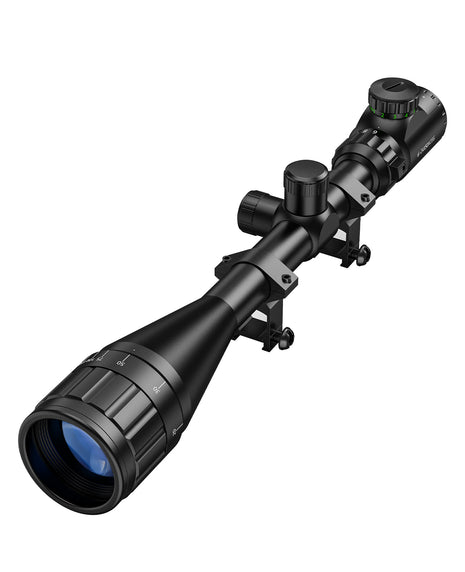
AO scopes feature a rotating dial ring built into the objective bell. Turning the ring shifts the front lens assembly forward or backward to match target distance focal depth.
Mechanics & Limitations
Lens movement is macro-adjusted, excellent for general distance correction
Requires breaking shooting form to reach forward and adjust
Less precise for fine-tuning at long range
Best for hunting, where distances change slowly and steadily
2. Side-Focus (SF / Side Wheel Adjustment)
Side-focus systems adjust internal erector lens positioning rather than the objective lens. This design delivers smoother, finer incremental adjustments and eliminates parallax more accurately at ultra-long ranges.
Adjustable without breaking cheek weld or shooting posture
Performs better for fast-changing distance target arrays
Preferred for precision range shooting and competitive training
Feature
AO Adjustable Objective
Side-Focus Adjustment
Internal Lens Movement
Front objective lens shift
Internal erector group fine shift
Adjustment Precision
Standard correction
Premium micro-tuned correction
Shooting Posture Disruption
High (must reach forward)
None (hand stays near stock)
Best Effective Range
Short-medium range hunting
Variable & long-range precision
Residual Parallax Risk
Slightly higher
Nearly zero
Professional Parallax Testing Method: Head Shift Verification
Visual sharpness is unreliable. This is the industry standard test used by precision shooters to confirm 100% parallax elimination:
Secure your rifle in a stable rest and aim at a precise target point
Lock your rifle completely stationary
Slowly shift your eye left, right, up, and down within the eye box
Watch reticle movement closely
If the reticle drifts across the target: parallax still exists.If the reticle stays perfectly locked on target through all eye movement: parallax-free.
How To Adjust Parallax Correctly For Any Distance
Most beginners adjust parallax backwards. Follow this correct professional sequence:
Step 1: Set Eyepiece Diopter FIRST (Critical)
Diopter adjustment focuses only the reticle. If your reticle is blurry, you cannot judge parallax correctly. Set diopter once for your eyesight and do not change it during range sessions.
Step 2: Match Knob Distance Marking To Target Range
Turn AO ring or side-focus wheel to your estimated target yardage.
Step 3: Fine Tune Beyond Printed Markings
Factory printed scales are approximate. Always fine-tune slightly forward or backward until head-shift testing shows zero drift.
Step 4: Recheck After Magnification Changes
Magnification shifts alter focal plane depth. Always re-verify parallax after changing zoom levels.
The Most Dangerous Parallax Misconception (Must-Know)
Myth: Parallax adjustment sharpens your reticle.
Fact: Parallax adjustment sharpens the TARGET IMAGE. Reticle clarity is controlled solely by the eyepiece diopter.
Mixing these two functions is the #1 reason new shooters never fully eliminate parallax error. Adjusting parallax will never fix a blurry reticle, and adjusting diopter will never fix floating reticle drift.
Many budget scopes advertise “no parallax adjustment needed” because they are factory-set parallax-free at 100 yards.
The hidden flaw: At 50yd, 25yd, or close-quarter shooting, fixed parallax creates massive aiming deviation. This is why many hunters shoot perfectly at 100 yards but experience unexplained misses in thick, close terrain.
Final Professional Takeaways
Parallax is focal plane mismatch — not blur, not zero shift
Close-range shooting suffers the worst parallax error
Side-focus offers superior precision for dynamic long-range shooting
AO works reliably for steady-distance hunting scenarios
Always test with head movement — never trust visual sharpness alone